Want your own version? Make it free in our texture roller tool. A free account gives you free downloads every week.
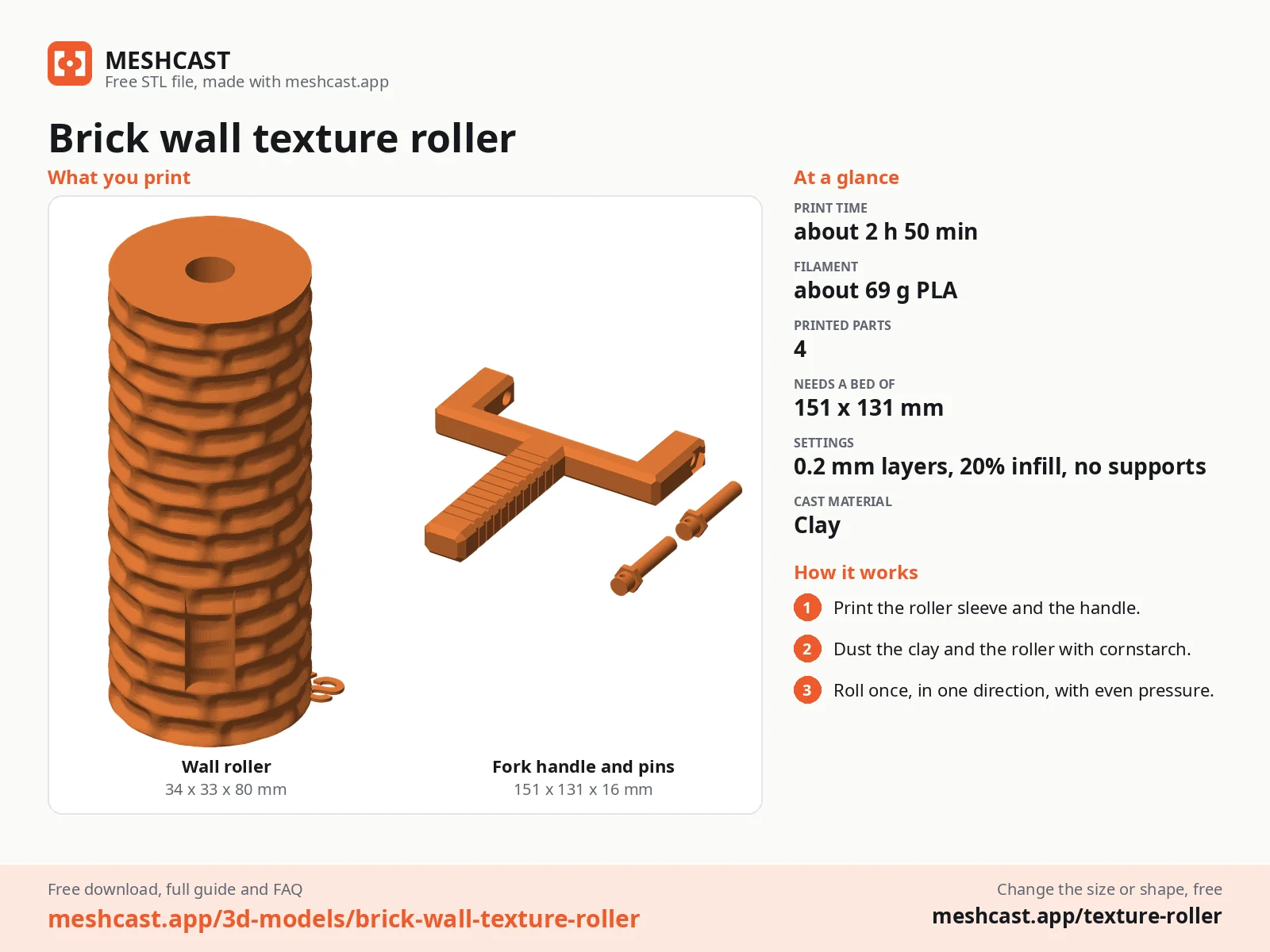
Clay~69 g
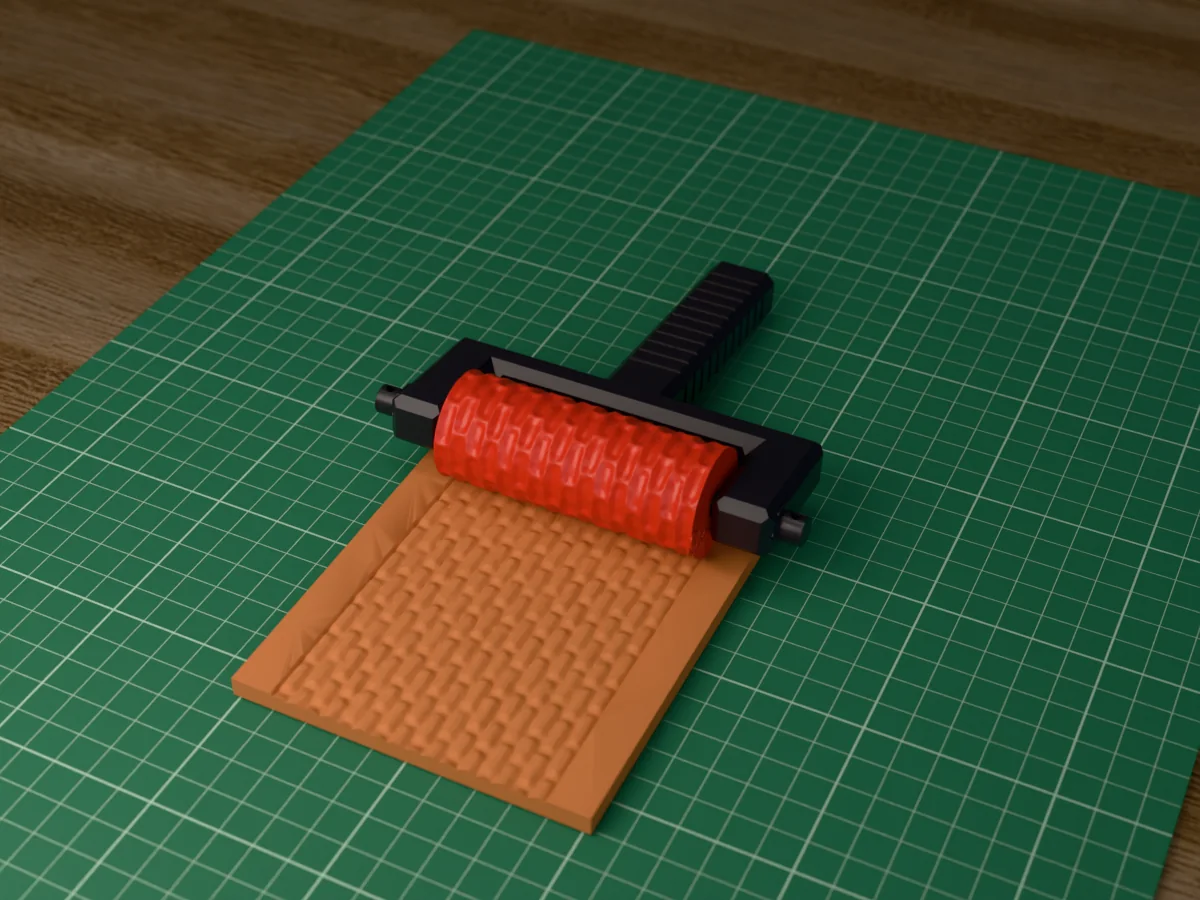
Eight courses of bricks on every repeat, laid in a running bond, each brick a little different in length, height and wear, with chipped corners, a pitted face and recessed mortar lines. Roll it into air-dry clay or foam for dungeon walls, ruined houses and wargaming buildings, or into polymer clay for miniature fireplaces, chimneys and dollhouse walls.
Read more
Made with our free texture roller tool, not modelled by hand: we drew the pattern in code as a seamless picture, uploaded it, and set a roller 30 mm across and 80 mm long with an 8 mm bore, the pattern raised 1.5 mm and repeated twice round and twice along. The zip holds the roller and the tool's own fork handle with its two retaining pins, as two STL files, plus the pattern picture, so you can remake the roller at another size or depth.
Every roller in this set is the same size and fits the same 131 mm handle, so you print the handle once and after that only rollers: pull the two pins, swap the roller, push the pins back in.
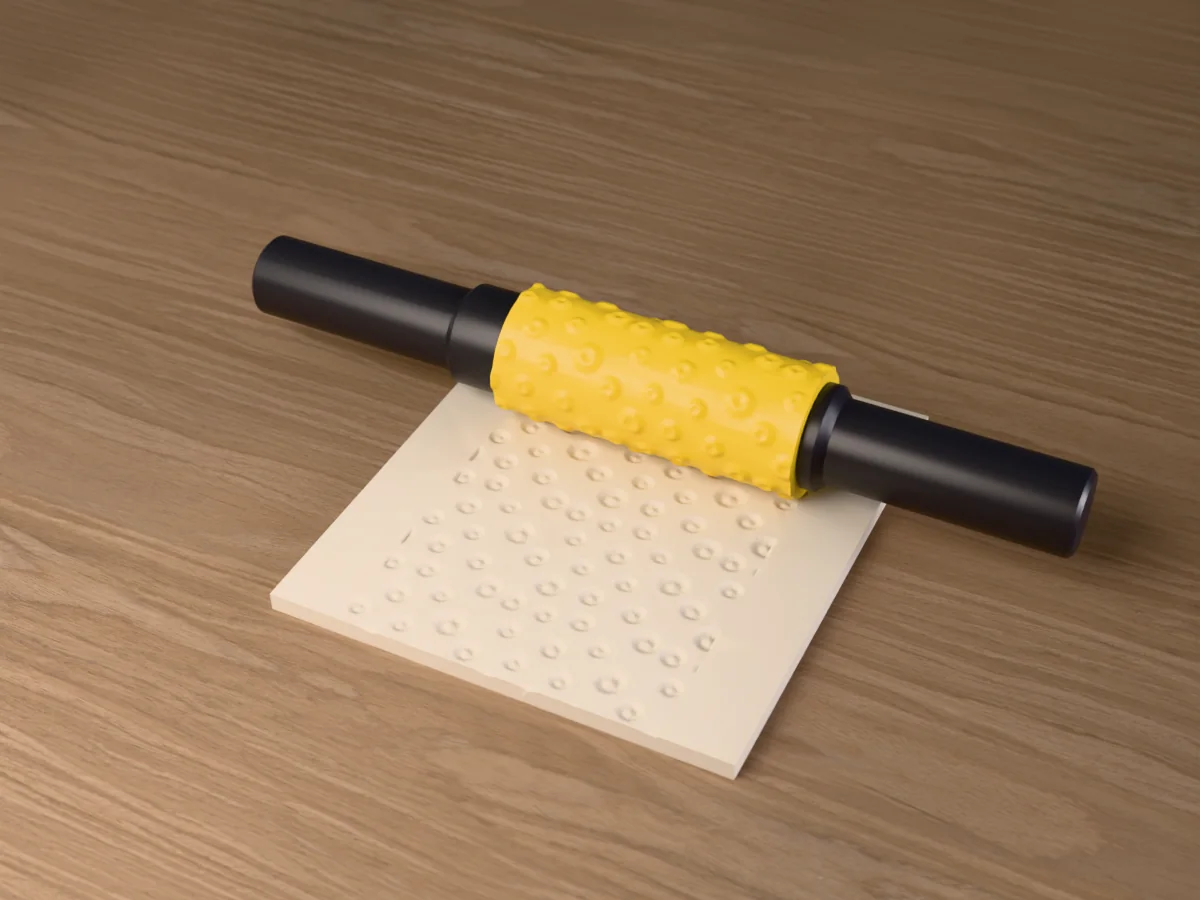
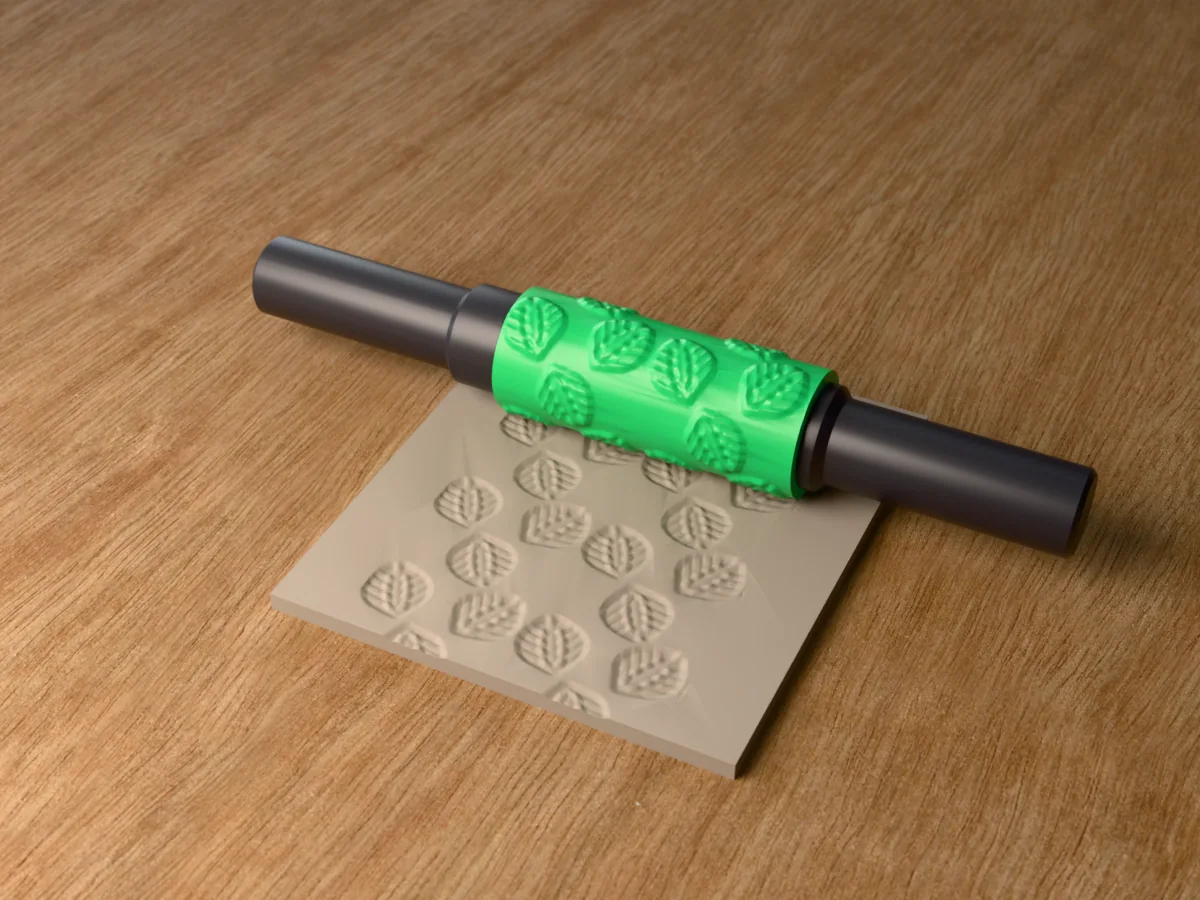
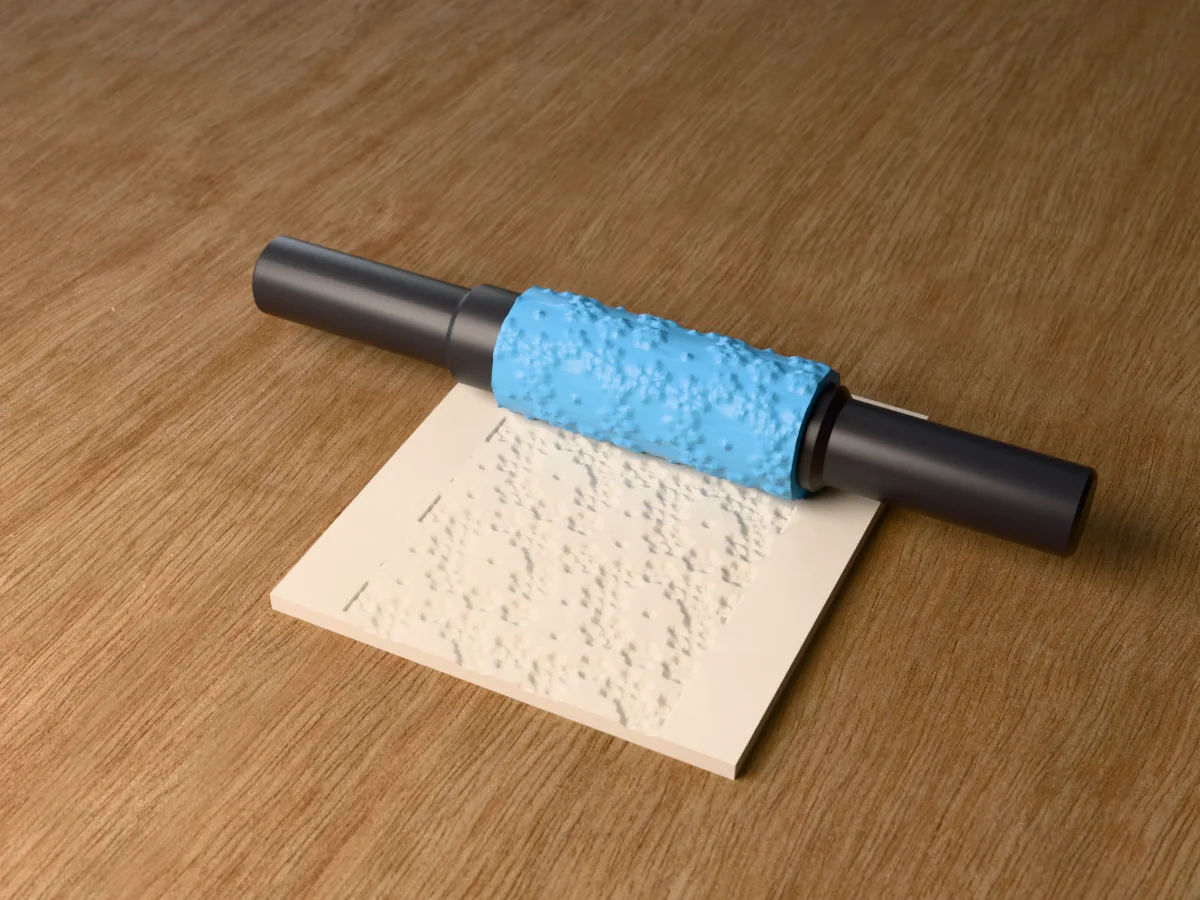
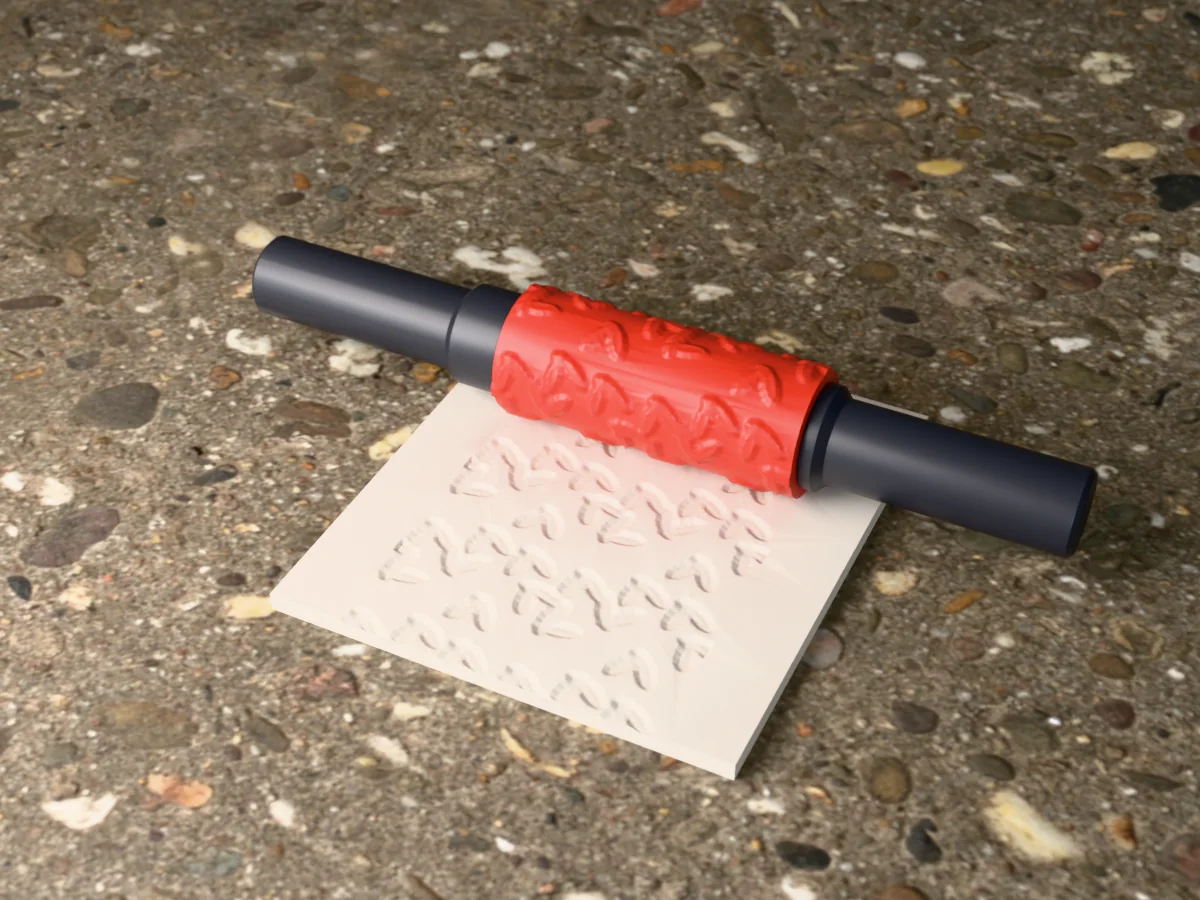
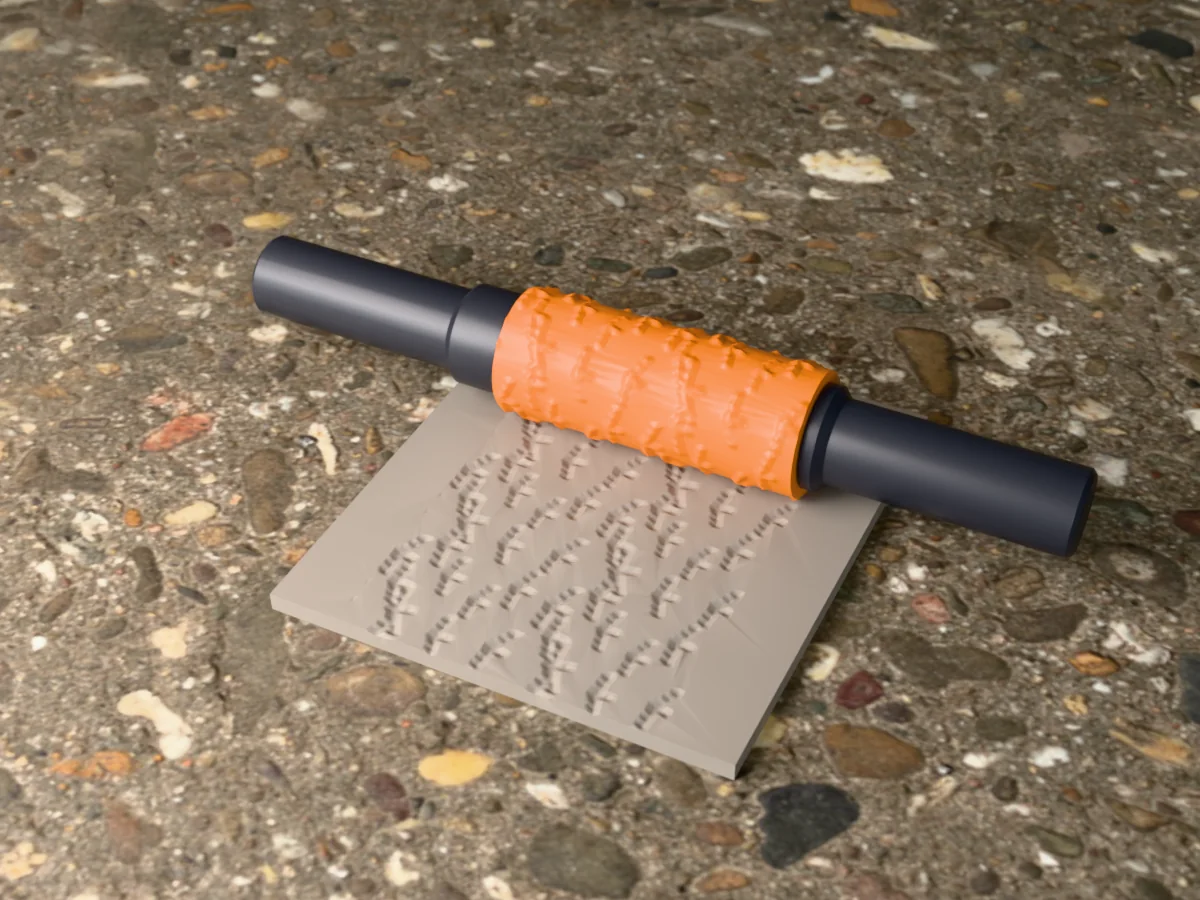
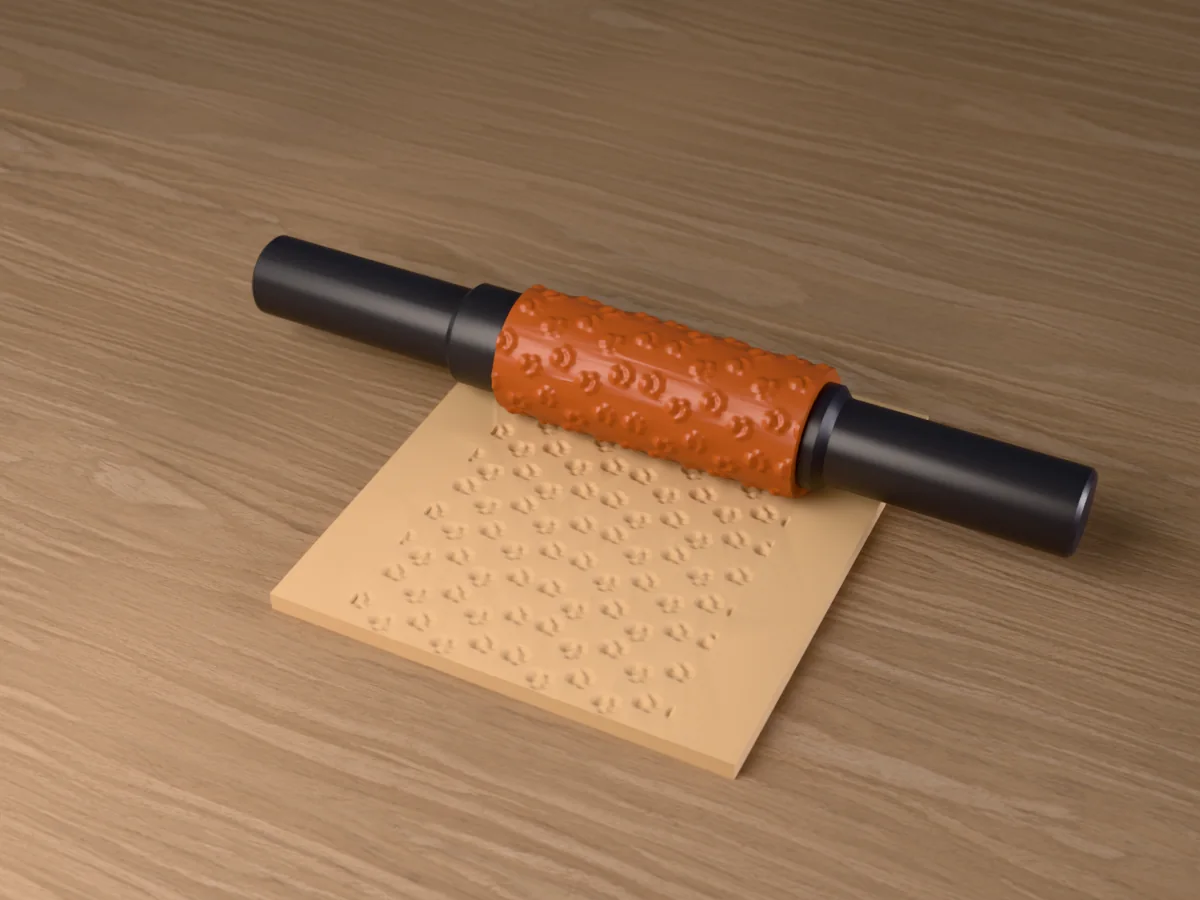
Shown as a 3D render of the printed roller in its handle on the clay it has pressed, not a photo.
What you need
4
About 69 g of PLA or PETG for the roller, the handle and its pins (about 32 g for a roller alone)
Something to texture: air-dry or polymer clay, or EVA foam warmed with a heat gun
A smooth work surface, and a rolling pin or two guide strips to roll the clay to an even thickness
A little cornstarch, or a water spray for ceramic clay, if it starts to stick
How to use it
5
1
Print the roller standing on its end and the handle and pins lying flat, all as exported, no supports.
2
Set the roller between the arms of the fork and push one pin through each arm into its bore, hex head outwards; the roller turns on the pins.
3
Roll the clay to an even thickness first: 4 to 6 mm for terrain and slabs, 2 to 3 mm for jewellery and ornaments.
4
Roll across once, in one direction, with steady, even pressure, and lift off at the end. Going back and forth doubles the pattern.
5
Pull the pins to swap to another roller from the set, and wash the roller in warm soapy water after use.
Free download. Opens the Thingiverse listing in a new tab.
Free for personal use. Selling the printed piece itself needs a commercial licence (Pro or Founder); passing on the file is not permitted on any plan. Full terms.
How big are the bricks on the brick wall texture roller?
About 12 by 4 mm, with mortar lines of roughly 1.3 mm. Next to a 28 mm figure that reads as large old bricks or small dressed stone, and at 1:24 dollhouse scale as ordinary bricks on a chimney or a garden wall.
Can I make standing walls with the brick wall texture roller?
Yes. Roll a slab of air-dry clay about 5 mm thick, texture it, and let it firm up until it is leather hard. Then cut wall panels with a craft knife against a ruler and glue them to a foam or card box once they have dried.
Does the brick wall texture roller fit the same handle as the other rollers?
Yes. Every roller in this set is 80 mm long and 30 mm across at the base, with an 8 mm bore, and every zip carries the same fork handle and pins, so you print the handle once and swap rollers by pulling the two pins.
How long does the brick wall texture roller take to print?
About 2 h 50 min for everything on a current printer at 0.2 mm layers: about 1 h 15 min for the roller and 1 h 30 min for the handle and pins. Once you have the handle, each new roller is only the first part. The times are estimated from the parts' volume, not sliced.