A standard six-sided die, 22 mm on each side, with rounded edges and round, dimpled pips arranged so opposite faces add up to seven, like a real die.
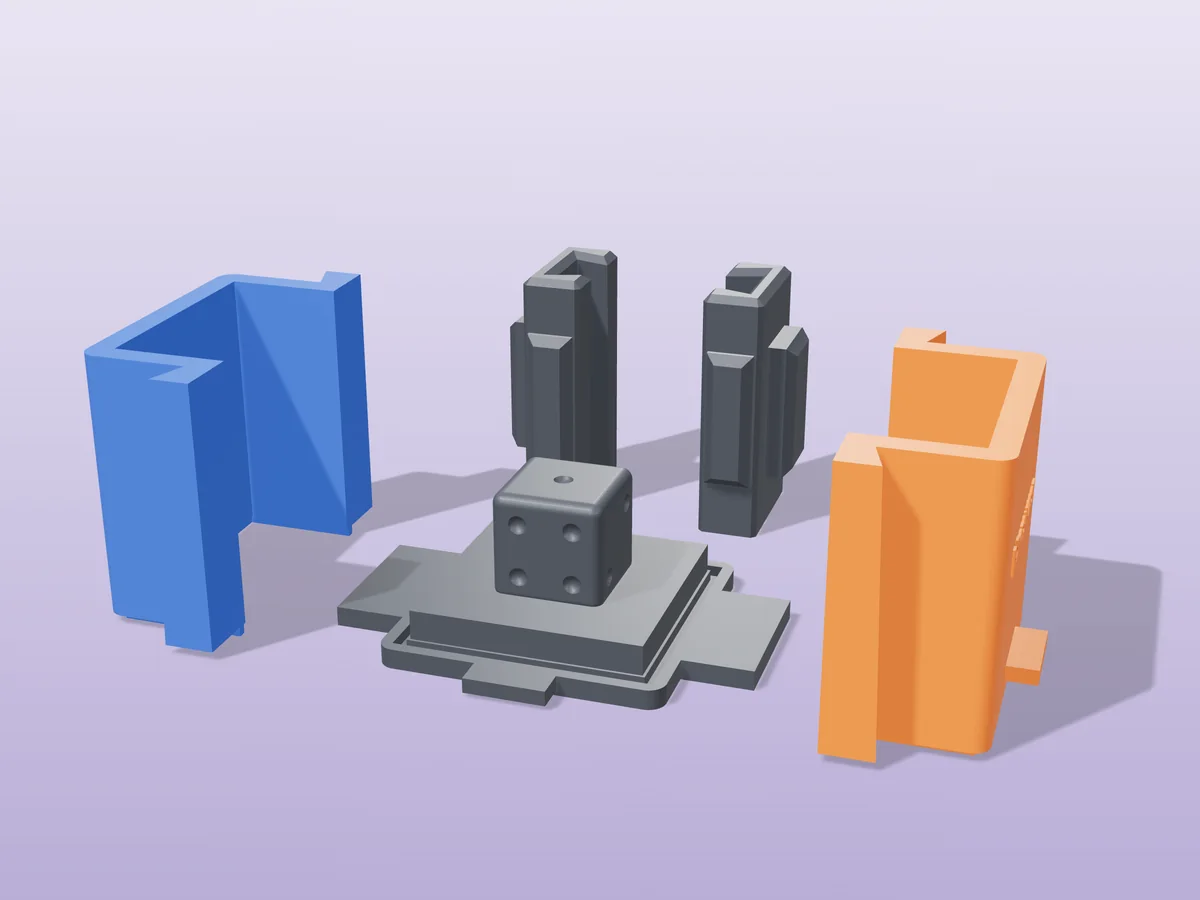
Made with the box mode of our silicone mold maker: print the base with the die fused onto it, the walls and the clamps, pour about 87 ml of silicone, and the block you get is a mold that copies every pip. Pour epoxy or UV resin into it, add glitter, flakes or a tiny inclusion, and paint the pips once it has cured.
The zip carries every printed part, the die master as its own STL, the tool's own print-settings sheet and a recipe file for the generator.
Shown as a 3D render of the printed mold parts pulled apart around the master, not a photo.
What you need
- About 106 ml of silicone (mix it in one batch)
- Epoxy or UV resin: each die is 10 ml
- Mica, glitter or alcohol ink if you want colour
- Acrylic paint or a paint pen for the pips
How to cast it
- Print the base with the master fused onto it, the two walls and the two clamps.
- Stand the walls on the base, slide the clamps over the corners, and seal the outside seams with tape or hot glue.
- Mix 106 ml of silicone in one batch and pour it into a corner, letting it rise around the master until it covers the top.
- Once it has cured, take the clamps and walls off and pull the silicone block off the master. That block is your mold.
- Turn the block over: the opening is one face of the die. Fill it slowly, pop the surface bubbles with a lighter or a heat gun, and let it cure fully.
- Demold, sand the flat face the opening left on fine wet paper, then paint the pips and wipe the paint off the surface.
| Cast material | Resin |
|---|---|
| Total print time | 7 h 34 min |
| Printed parts | 5 |
| Size (W x D x H) | 84 x 68 x 56 mm |
| Filament | ~97 g |
| Layer height | 0.2 mm |
| Infill | 15% |
| Supports | Not needed |
| Printer | Sliced with PrusaSlicer 2.7.2: 0.4 mm nozzle, 0.2 mm layers, 3 walls, 15% infill, MK3-class speeds. These parts only hold liquid silicone while it cures, so PLA is fine. No supports. |
| Download | ZIP: 5 printed parts (STL) + dice master (STL) + print sheet + recipe |
| Added | 2026-09-24 |
Pro early access until October 24, 2026, then free with any account.
Free for personal use. Selling the pieces you cast needs a commercial licence (Pro or Founder); passing on the file itself is not permitted on any plan. Full terms.
Made with the free silicone mold maker generator. Upload your own model and get the same kind of mold built around it, in your browser.
New to casting? Read the silicone mold maker guide.