Block mold or contoured shell?
This guide was drafted with AI assistance.
Block (box) mold for your first molds, flat or boxy shapes and small parts: one pour, few printed parts. Contoured hugging shell for tall, round or irregular models, where a box would bury the master in silicone you pay for: on our heart sample it took half the silicone.
The quick decision
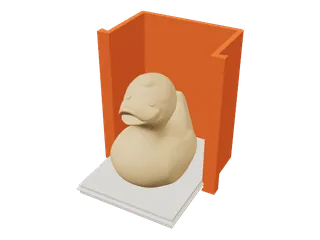 Block / box moldA rigid box around the master, filled with silicone.
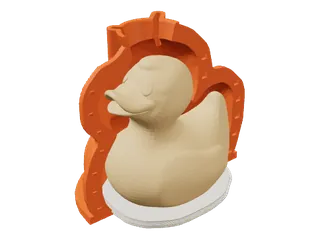 Contoured hugging shellShells follow the model, an even layer of silicone.
| Your model | Pick |
|---|---|
| First silicone mold ever | Box |
| Flat or boxy (soap bar, tile, coaster) | Box |
| Small part, a few ml of silicone either way | Box |
| Tall figure, bust or statue | Hugging shell |
| Round or irregular shape (vase, animal, organic) | Hugging shell |
| Deep undercuts that need the mold to open | Hugging shell |
| Expensive silicone (platinum, food grade) | Hugging shell |
Side by side
| Block / box mold | Contoured hugging shell | |
|---|---|---|
| What you print | A base, walls and clamps (or a round box) | Two shells that close around the master, a funnel on top |
| Silicone | Fills the whole box | An even layer around the model |
| Pouring | One pour from the top | Poured through the funnel into the closed shells |
| Demolding | Take the box apart, peel or cut the master out of the block | Open the two shells, then flex the silicone off the master |
| Best at | Simple shapes, beginners, small parts | Tall and organic shapes, saving silicone |
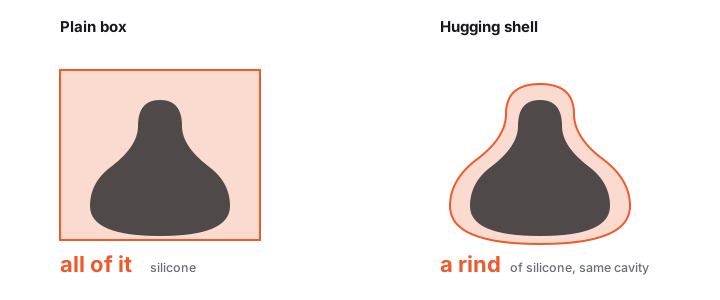
How much silicone each one takes
Silicone is the expensive part of the job, so this is usually what decides it. Measured in our own tool:
| Model | Box mold | Hugging shell | Saved |
|---|---|---|---|
| Heart sample (32 x 4 x 29 mm) | 81 ml | 39 ml | 52% |
The rule behind it: a box costs the volume of the box minus the model, a shell costs roughly the model's surface times the gap. The more your model differs from a box (tall, round, thin parts sticking out), the more a shell saves. On a soap bar it saves almost nothing.
When the box wins
- Your first molds. Few parts, one pour, nothing to line up. Mistakes are easy to see and fix.
- Flat and boxy shapes. Soap bars, tiles, coasters, badges: the box already fits closely, so a shell saves little.
- Small parts. When either way is a few millilitres, simplicity wins.
- A mold that stands on its own. The thick block of silicone keeps its shape on the table while you pour.
When the hugging shell wins
- Tall figures and busts. A box around a 15 cm bust is mostly silicone you never needed.
- Round and organic shapes. Vases, animals, faces: the shell follows the curves.
- Undercuts. An even, thinner layer of silicone flexes off shapes that would grip hard in a thick block.
- Pricey silicone. Platinum-cure and food-grade silicone cost more per kilo, so halving the amount matters more. See platinum vs tin cure.
Not sure you need silicone at all? A rigid printed mold is often enough for candles, soap and plaster: silicone vs direct-print molds, or go straight to the candle mold maker or the plaster mold maker.
Questions
How much less silicone does a contoured mold use?
It depends on the shape. On our heart sample the box mold takes 81 ml and the hugging shell 39 ml, 52% less.
On a near-cuboid shape like a soap bar the difference is small, because a box already fits it closely.
Is a contoured mold harder to make?
A little. You print two shells that close around the master, with a funnel on top for the silicone, and they have to line up.
A box is one pour into a simple container. The silicone amount is what usually decides it.
Which one is better for beginners?
The box mold. Fewer parts, one pour, nothing to line up.
Switch to the hugging shell when the silicone for a box starts to cost real money, usually on tall or irregular models.
Can I switch between the two on the same model?
Yes. The silicone mold maker has both modes on one page. Upload once, and the box mode shows how much silicone a hugging shell would save on that exact model.
Made by meshcast.app. Got stuck? Email a photo and I'll help you debug.