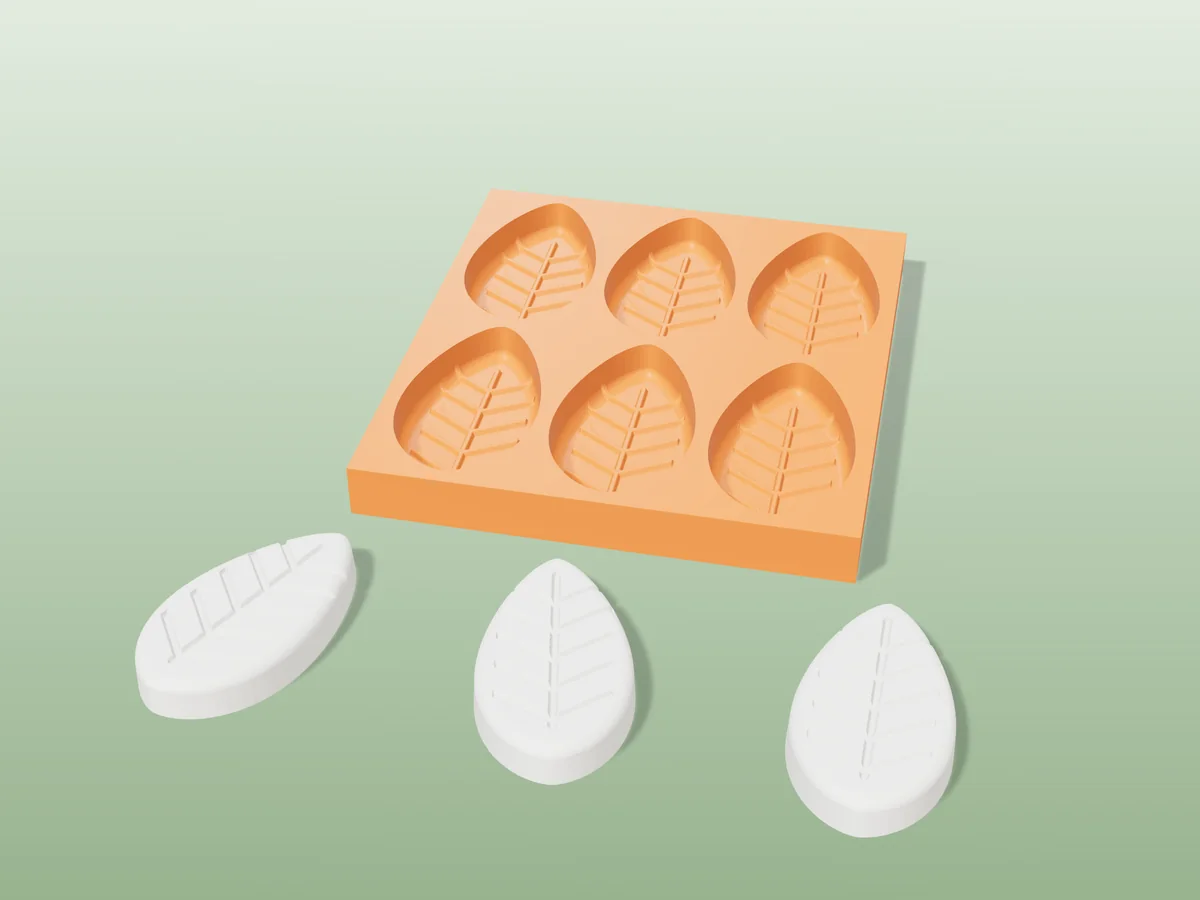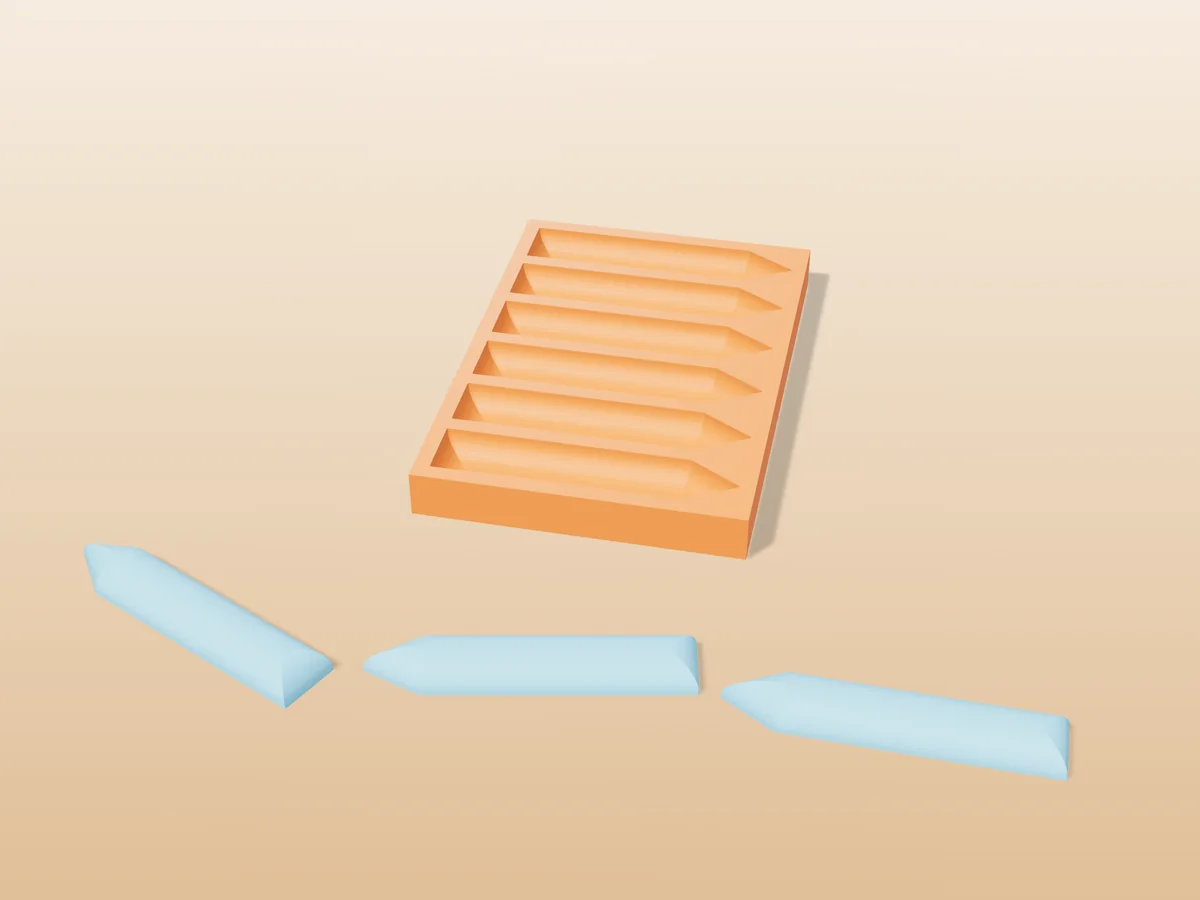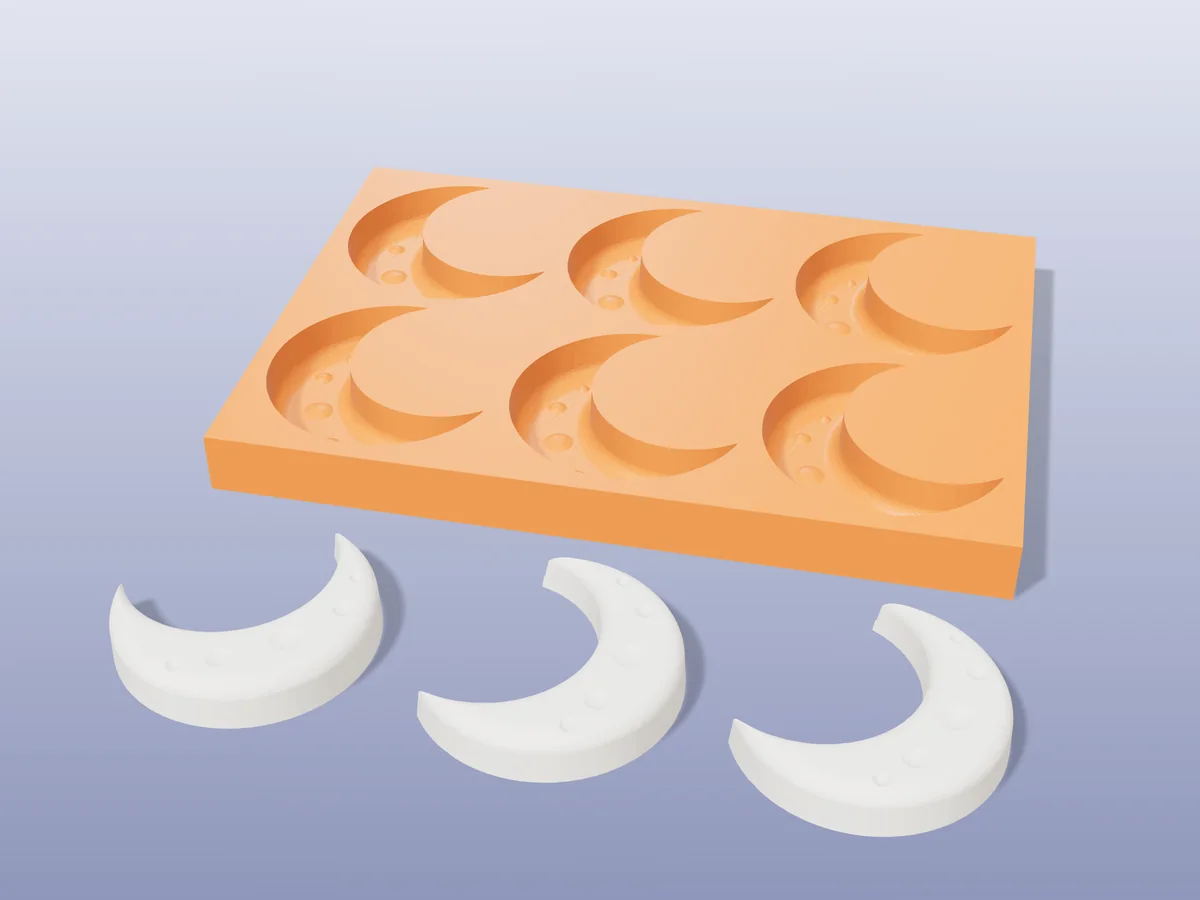
A printed tray for six crescent moons, 50 mm tall and 10 mm thick, with rounded edges and a scatter of small craters pressed into the face. A small celestial gift that also works as an aroma stone or a place card.
Made with our tray mold generator in its rigid tray mode: print the tray, wipe in a release agent and pour plaster, Jesmonite or a fine concrete straight in. The crescent has no overhangs anywhere, so each moon tips out of the rigid tray.
The zip carries the tray exactly as the tool exported it, one moon on its own as an STL, the master uploaded to the tool, and a print and pour sheet with the volume of each cavity.
Shown as a 3D render of the printed tray with three white plaster moons in front, not a photo.
What you need
- Casting plaster or Jesmonite, about 9 ml per moon
- Mold release, petroleum jelly or cooking spray
- Gold leaf or metallic paint for the craters, if you like
How to cast it
- Print the tray as exported, cavities up, no supports. PLA is fine: plaster only gets warm as it sets.
- Wipe a thin film of mold release, petroleum jelly or cooking spray into every cavity, including the fine detail.
- Mix casting plaster to a pouring cream (add pigment now if you want colour), fill each cavity and tap the tray on the table for a minute to lift the bubbles.
- Leave it for an hour until the plaster is warm and hard, then flex the tray corners and tip the pieces out. Let them dry for a day before you add oils or paint.
| Cast material | Plaster |
|---|---|
| Total print time | 8 h 45 min |
| Printed parts | 1 |
| Size (W x D x H) | 166 x 116 x 14 mm |
| Filament | ~101 g |
| Layer height | 0.2 mm |
| Infill | 15% |
| Supports | Not needed |
| Printer | Sliced with PrusaSlicer 2.7.2: 0.4 mm nozzle, 0.2 mm layers, 3 walls, 15% infill, MK3-class speeds. You pour straight into this tray, so PLA is fine: plaster and concrete only get warm as they set. No supports. |
| Download | ZIP: printed tray (STL) + one aroma stone (STL) + tool master (STL) + print and pour sheet |
| Added | 2026-09-24 |
Pro early access until October 24, 2026, then free with any account.
Free for personal use. Selling the pieces you cast needs a commercial licence (Pro or Founder); passing on the file itself is not permitted on any plan. Full terms.
Made with the free ice cube tray mold generator. Upload your own model and get the same kind of mold built around it, in your browser.
New to casting? Read the ice cube tray mold guide.