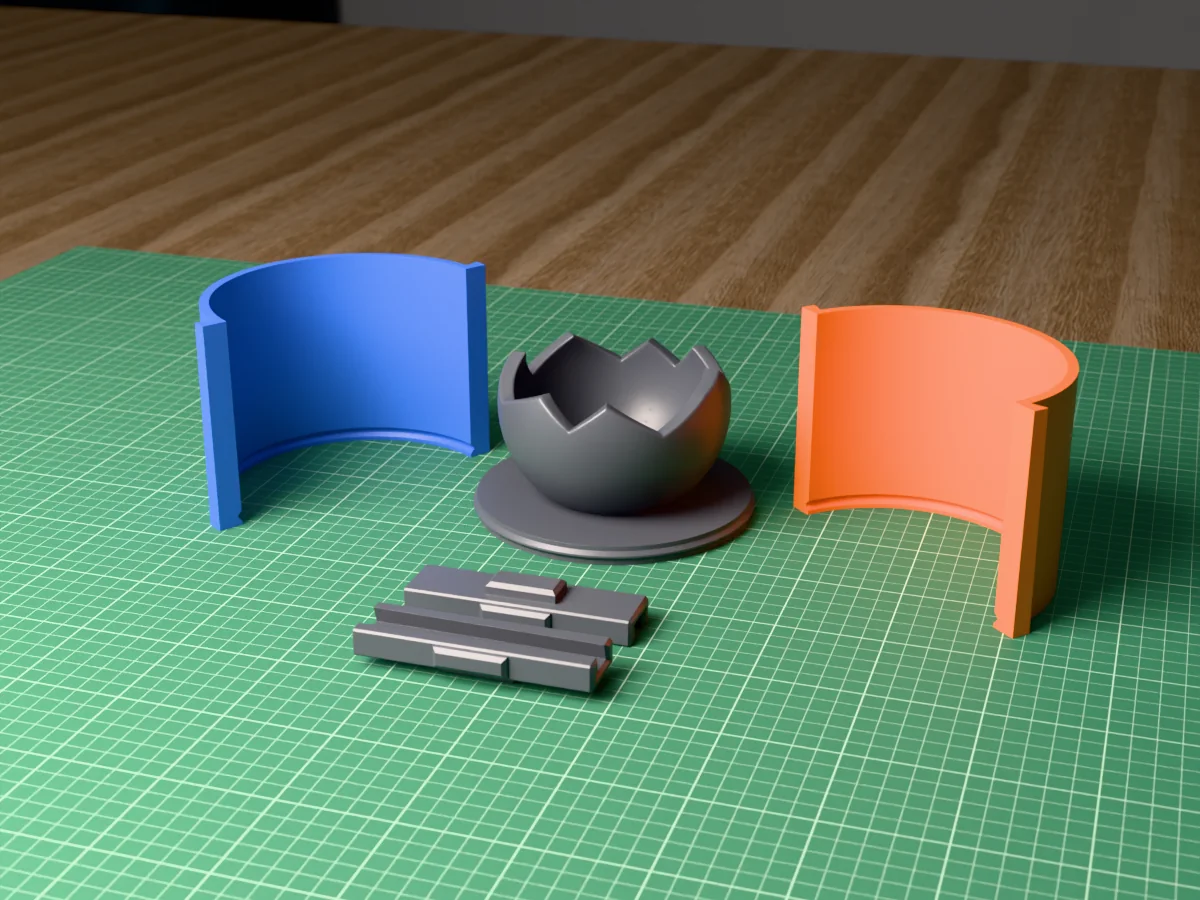
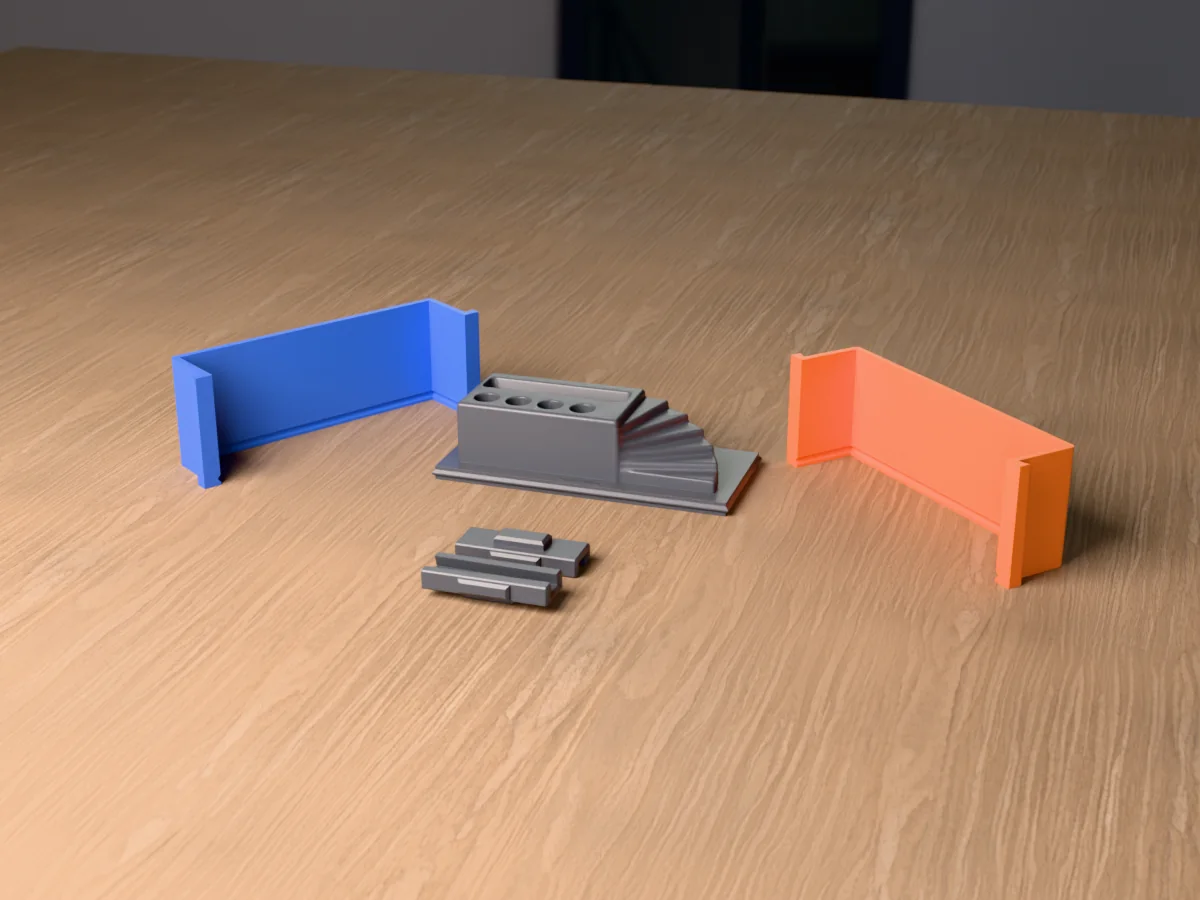
Want your own version? Make it free in our tray mold tool. A free account gives you free downloads every week.
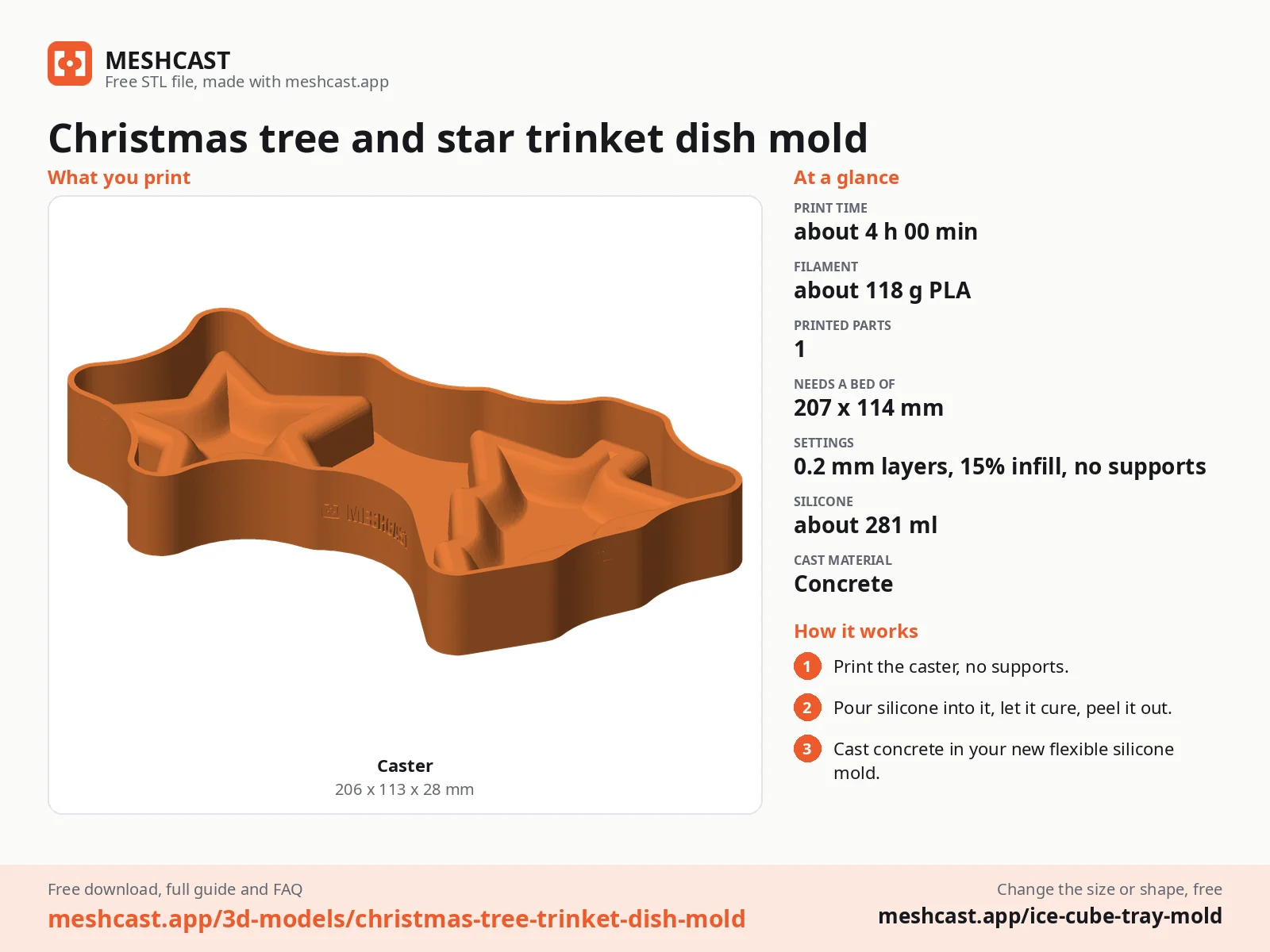
Concrete~118 g
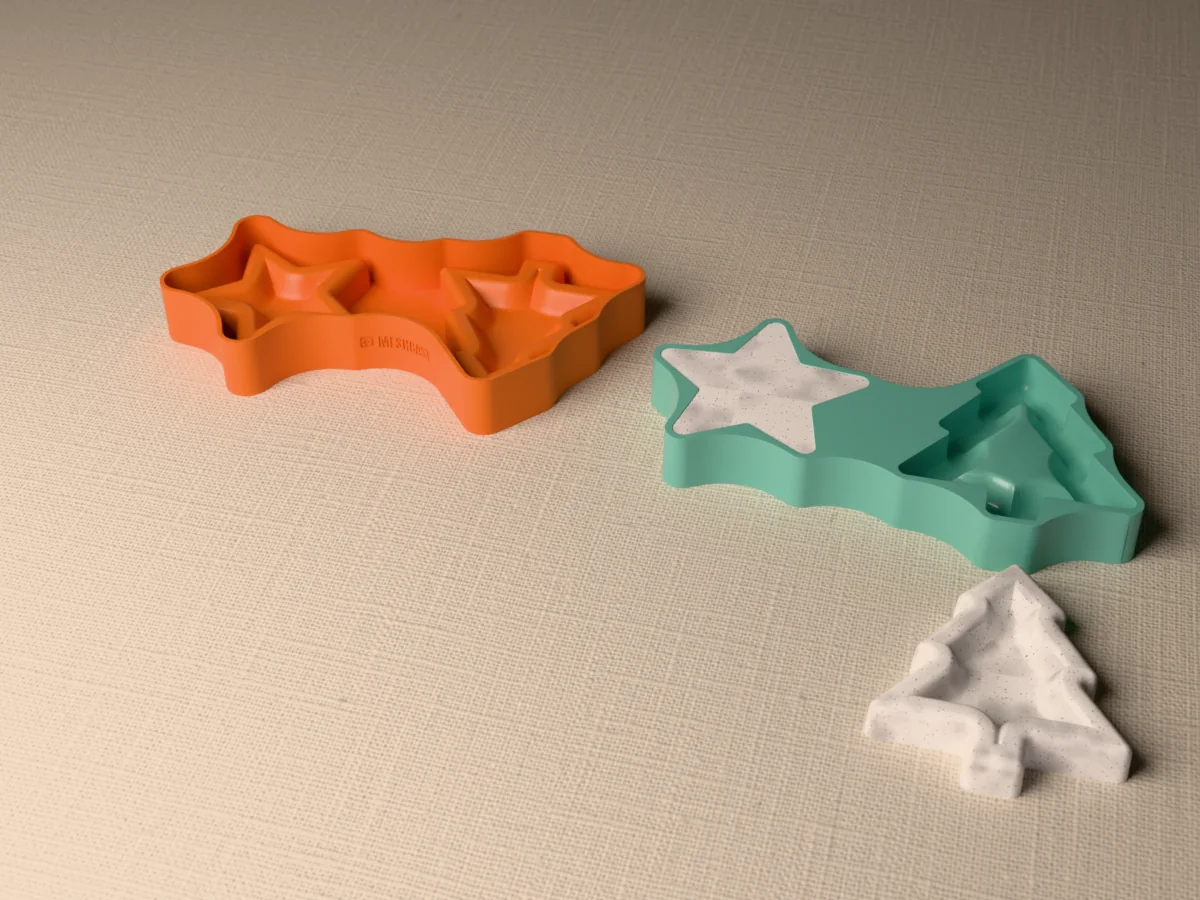
A silicone mold for two Christmas trinket dishes: a fir tree 94 by 101 mm with its trunk, and a five-point star 95 mm across, both 16 mm tall with a 10 mm deep well inside a 7 mm lip, every edge rounded. Together they take about 105 ml.
Read more
Made with our tray mold generator in its flexible silicone tray mode: print one part, a caster, pour silicone into it and peel it out. That silicone is the dish mold. The dishes are cast upside down: the raised shapes in the cavity form the wells, and the poured side becomes the flat underside.
Cast them in white Jesmonite with a terrazzo of red and green chips, in grey concrete with a gold rim, or in clear resin with glitter. A pair makes a gift on its own, or the box under a ring. The zip carries the printed caster exactly as the tool exported it, the two dishes on their own as an STL, the master uploaded to the tool, and a print and pour sheet with the silicone figure the tool measured.
Shown as a 3D render of the printed caster beside the silicone mold it pours, with the dishes, not a photo.
What you need
3
About 281 ml of silicone for the mold (mix it in one batch)
Jesmonite AC100, fine concrete or casting resin, about 105 ml for the pair
Pigments, terrazzo chips or gold leaf if you like, felt pads and a sealer
How to cast it
5
1
Print the caster as exported, open side up. It is one part, so there are no seams to seal. No supports.
2
Mix 281 ml of silicone in one batch and pour it into one corner of the caster in a thin stream, letting it rise over the dish shapes until it is level with the rim. Tap the caster on the table for a minute and let it cure for as long as its datasheet says.
3
Peel the cured silicone out of the caster. That silicone is your tray: the dome in the middle of each cavity is what forms the well of the dish.
4
Mix Jesmonite or a fine concrete to a thick pour and fill each cavity to the brim, about 105 ml each. Tap the tray on the table for a minute so the air lifts off the lip, the deepest part of the cavity.
5
Leave Jesmonite about an hour and concrete a full day, then flex the tray and peel it back. Sand the back flat and seal the dish once it is dry.
Print details
4 hPrint time
~118 gFilament
1Printed parts
206 × 113 × 29 mmSize (W x D x H)
All print details
Print details
Cast material
Concrete
Printed parts
1
Size (W x D x H)
206 x 113 x 29 mm
Print bed needed
207 x 114 mm, 29 mm tall
Filament
~118 g
Layer height
0.2 mm
Infill
15%
Supports
Not needed
Download
ZIP: printed caster (STL) + one tree dish and star dish (STL) + tool master (STL) + print and pour sheet
Made with the free Tray mold generator. Upload your own model and get the same kind of mold built around it, in your browser.
ZIP: printed caster (STL) + one tree dish and star dish (STL) + tool master (STL) + print and pour sheet
Free for personal use. Selling the pieces you cast needs a commercial licence (Pro or Founder); passing on the file itself is not permitted on any plan. Full terms.
Which material works best in the Christmas tree trinket dish mold?
Jesmonite AC100 gives the crispest edges and sets in about an hour, so you can pour several pairs in an evening. Fine concrete looks rougher and needs a day. Casting resin gives a glossy dish, but sand the caster smooth first: the silicone copies every layer line.
How do I make a terrazzo Christmas dish?
Pour a few spoonfuls of red and green Jesmonite on a sheet, let them set, break them into chips and fold the chips into white Jesmonite before you pour. Once the dishes have cured, sand the lip and underside with wet 120 then 400 grit paper to open the chips, and seal them.
Are the tree and star dishes food safe?
Not for food as cast: concrete, Jesmonite and most resins are not food safe, and the surface is porous. Use them for rings, keys, sweets in wrappers or a candle, or seal them with a food-safe coating that is rated for the purpose.