Want your own version? Make it free in our tray mold tool. A free account gives you free downloads every week.
Concrete~658 g
A silicone mold for a mid-century concrete breeze block, 150 by 150 mm and 50 mm deep, with four round openings 50 mm across and a small diamond in the middle, every edge rounded 3 mm. One block takes 800 ml, about 1760 g in concrete.
Read more
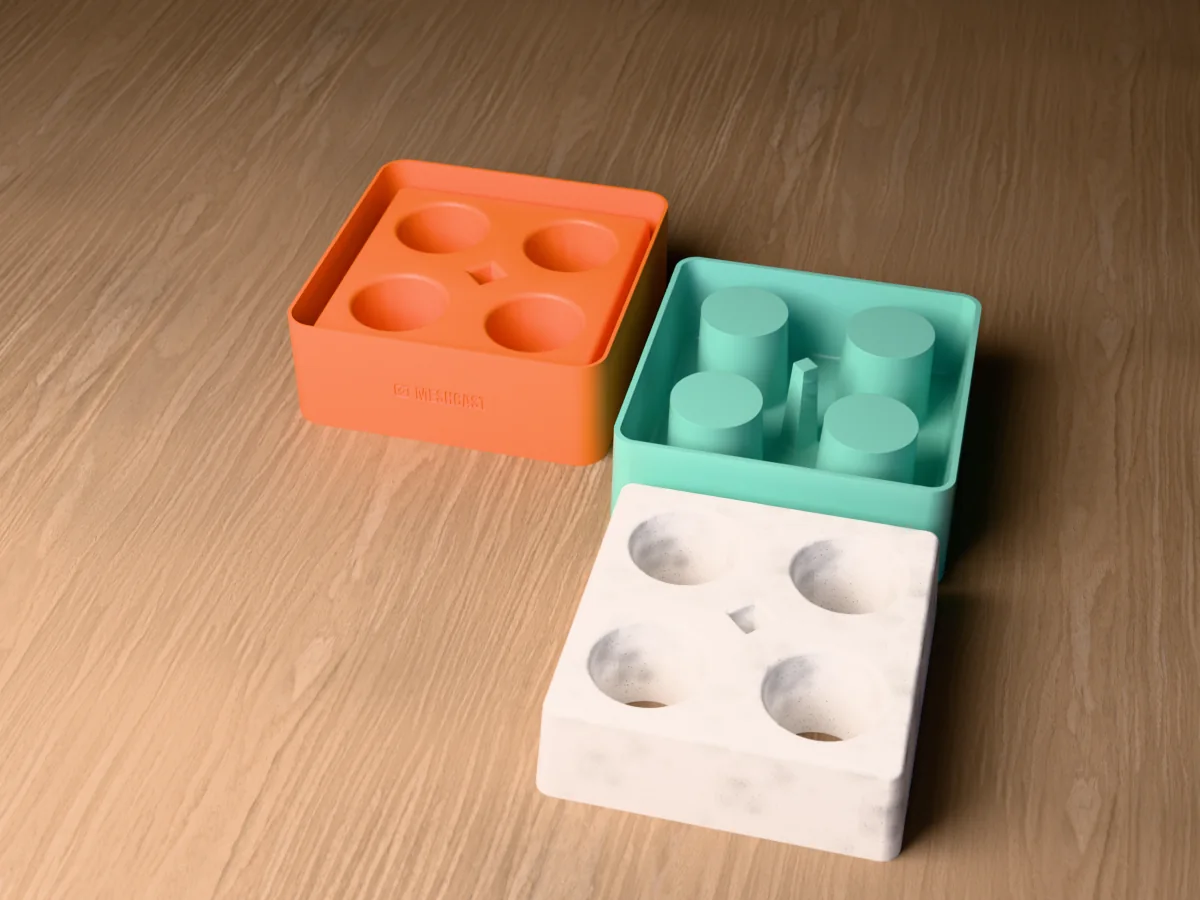
Made with our tray mold generator in its flexible silicone tray mode: print one part, a caster, pour silicone into it and peel it out. That silicone is the block mold. The openings are silicone posts 50 mm tall, which would grip a rigid printed mold; silicone peels off them. The block is cast face down, so the front comes off the smooth floor.
Stack and glue a few into a small screen wall, a garden planter front or a tealight shelf, or use one as a book end or a plant stand. The zip carries the printed caster exactly as the tool exported it, the block on its own as an STL, the master uploaded to the tool, and a print and pour sheet with the silicone figure the tool measured.
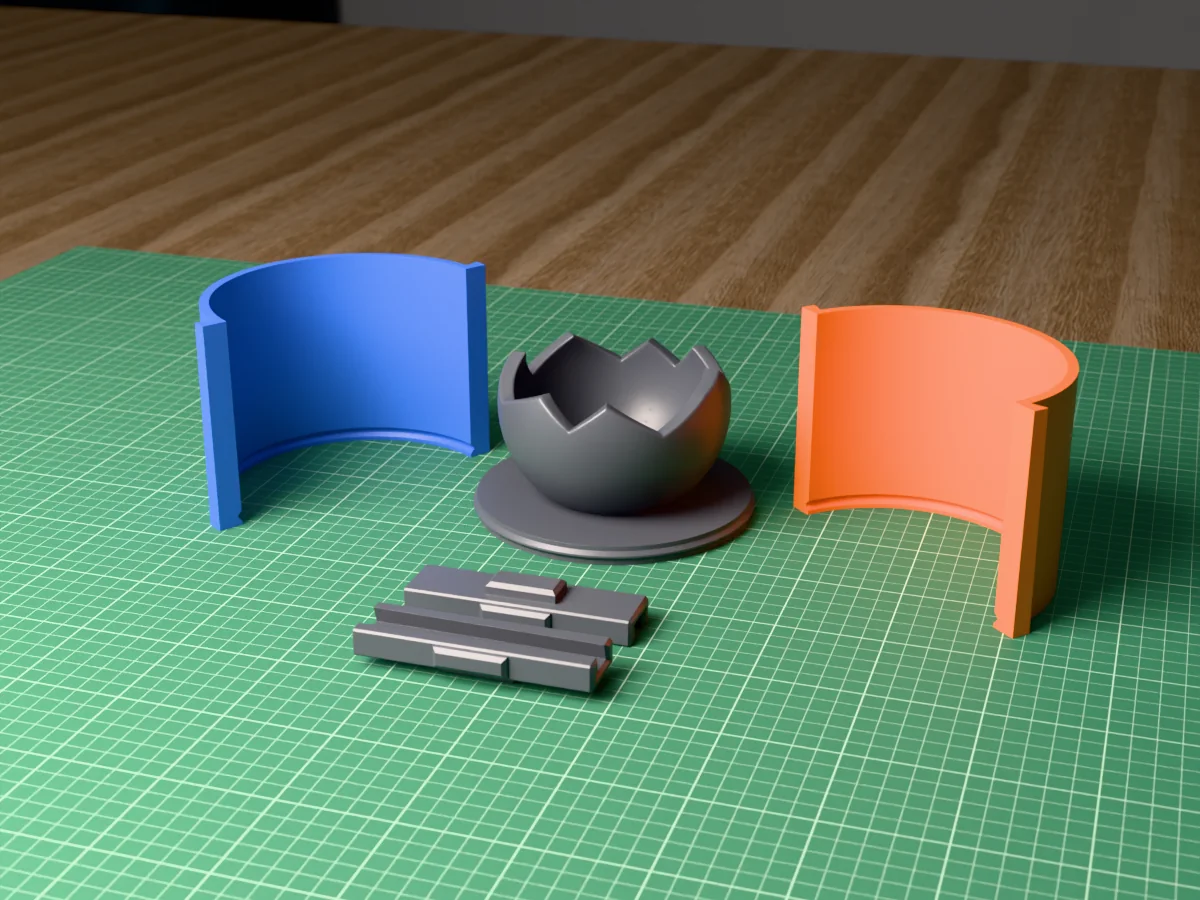
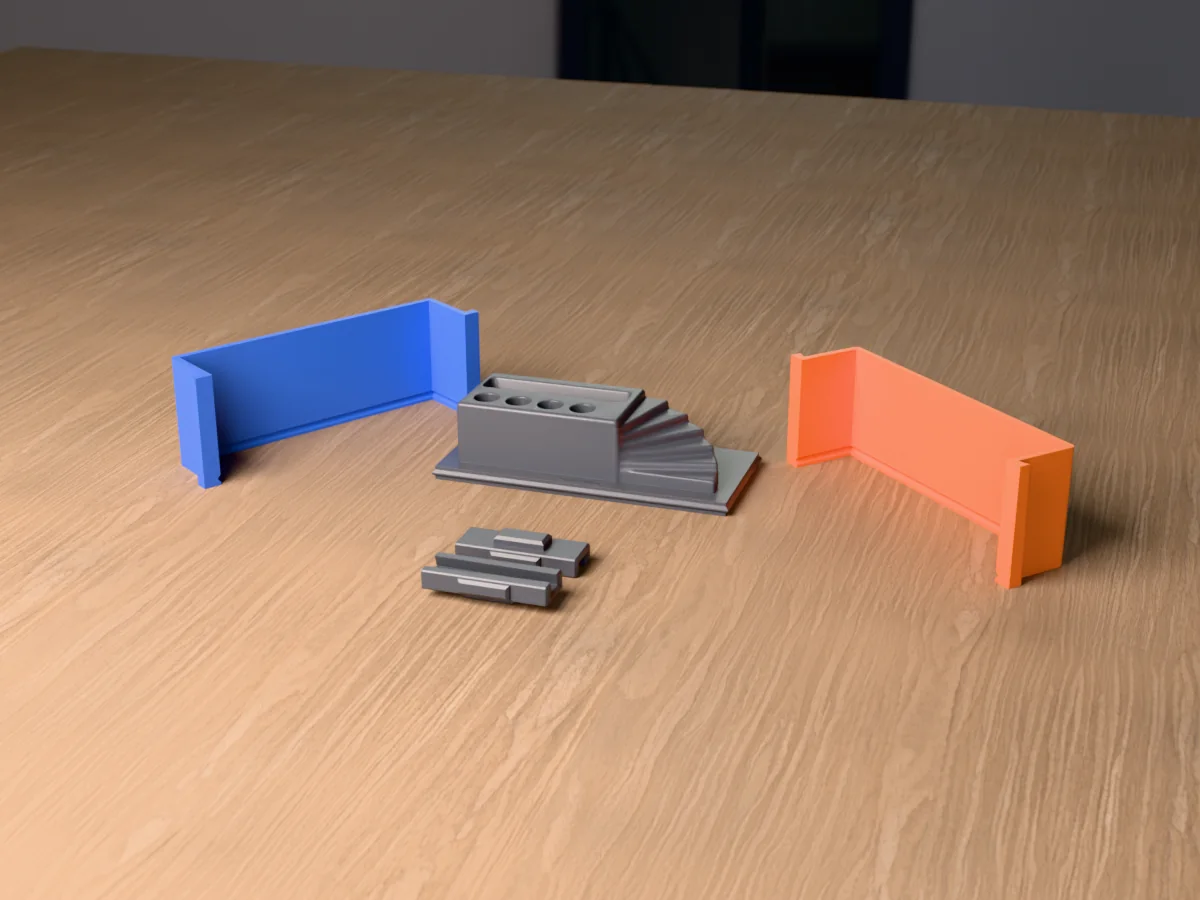
Shown as a 3D render of the printed caster beside the silicone mold it pours, with a concrete breeze block in front, not a photo.
What you need
3
About 962 ml of silicone for the mold (mix it in one batch)
Fine concrete with sand or Jesmonite: one block takes 800 ml, about 1760 g in concrete
Mold release, construction adhesive or mortar to join blocks, and a sealer for outdoors
How to cast it
5
1
Print the caster as exported, open side up, no supports. PLA is fine.
2
Set it on a level surface. Mix 962 ml of silicone in one batch and pour it into one corner in a thin stream until it covers the raised block to the rim. Tap the caster for a minute and let it cure as long as its datasheet says.
3
Peel the cured silicone out of the caster. That silicone is your mold, with the four openings as posts standing in it.
4
Brush a little release over the mold, then fill it with a fine concrete with some sand in it. Vibrate it, a sander against the side works, until no more bubbles rise, and strike the back flat.
5
Cover it and leave it 48 hours, then peel the silicone off the posts first and then off the sides. Let the block cure a week before it carries weight or goes outside.
Print details
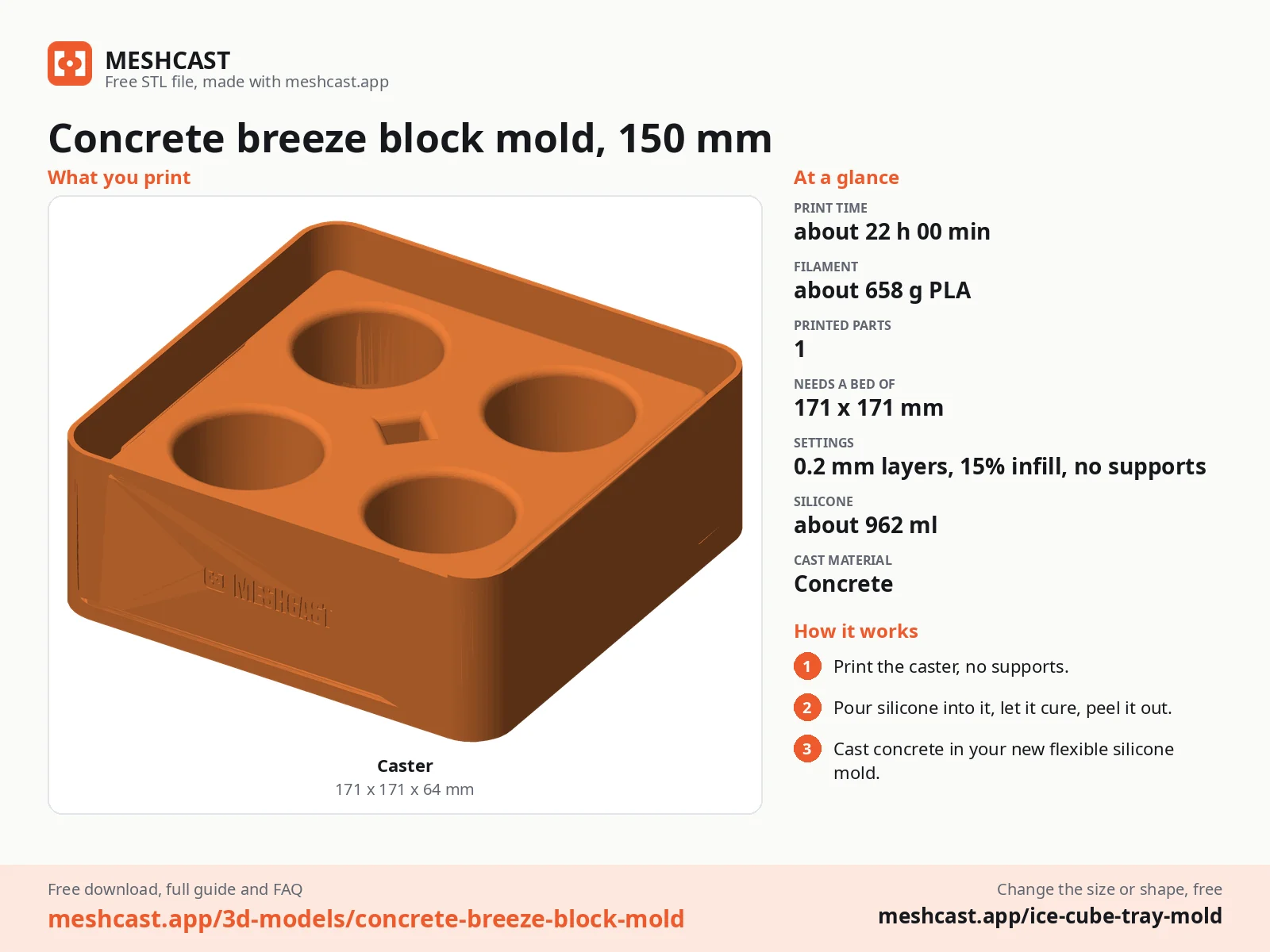
22 hPrint time
~658 gFilament
1Printed parts
171 × 171 × 64 mmSize (W x D x H)
All print details
Print details
Cast material
Concrete
Printed parts
1
Size (W x D x H)
171 x 171 x 64 mm
Print bed needed
171 x 171 mm, 64 mm tall
Filament
~658 g
Layer height
0.2 mm
Infill
15%
Supports
Not needed
Download
ZIP: printed caster (STL) + one breeze block (STL) + tool master (STL) + print and pour sheet
Made with the free Tray mold generator. Upload your own model and get the same kind of mold built around it, in your browser.
ZIP: printed caster (STL) + one breeze block (STL) + tool master (STL) + print and pour sheet
Free for personal use. Selling the pieces you cast needs a commercial licence (Pro or Founder); passing on the file itself is not permitted on any plan. Full terms.
Are the concrete breeze blocks strong enough for a garden wall?
For a low decorative screen or a planter front, yes, glued or mortared and on a firm footing. They are 50 mm deep, thinner than a building block, so do not use them as a load-bearing or retaining wall. Seal them for outdoor use.
How do I join breeze blocks into a screen?
Lay them in a stack bond (each block straight above the one below) and join them with a thin bed of construction adhesive or a fine mortar, about 5 mm. For more than four rows, run a threaded rod through the openings at the ends for stiffness.
Can I make a bigger breeze block with this mold?
The master is in the zip. Upload it to the tray tool, scale it and download a new caster in a minute. A 150 mm block is the largest that comfortably fits a common printer bed with the silicone wall round it; for bigger blocks, print the caster on a large bed.