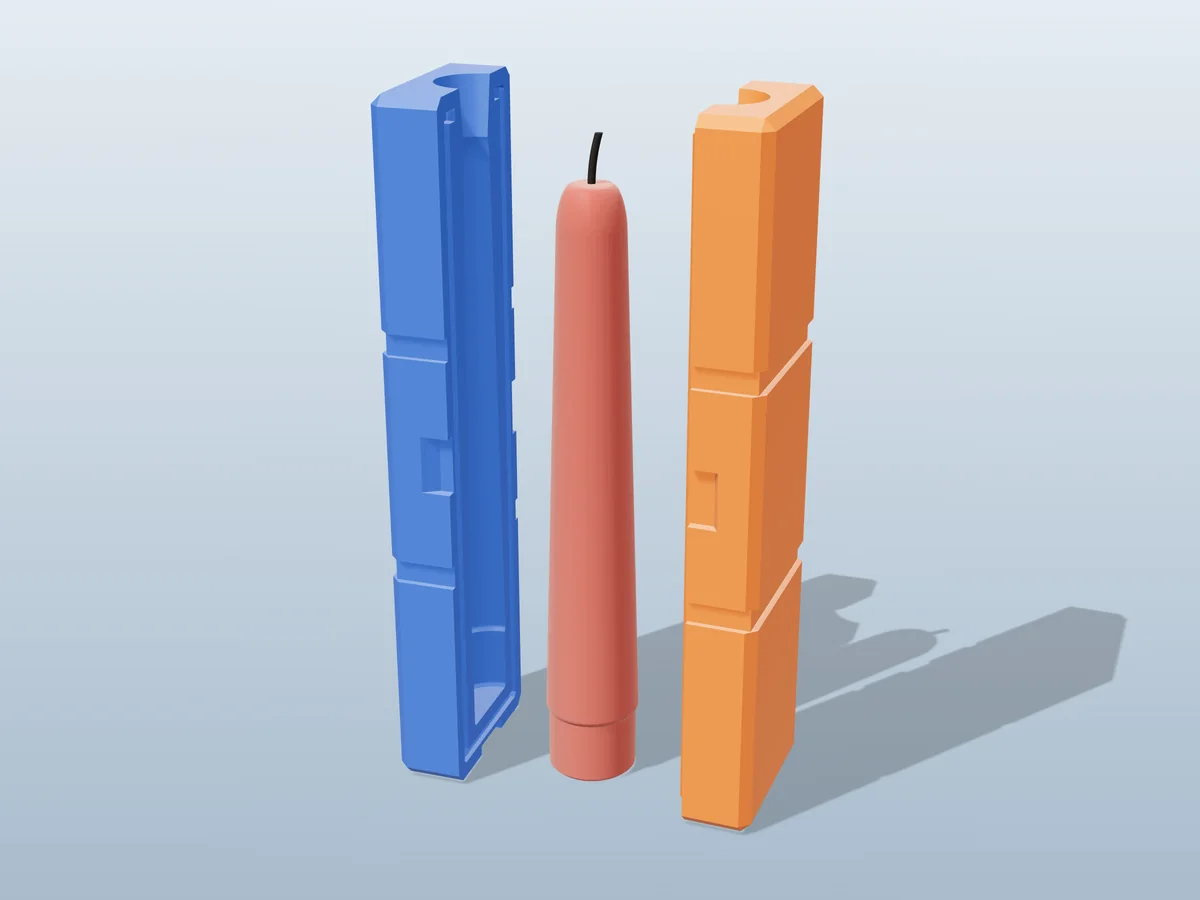
A classic taper candle 150 mm tall. The foot is 22 mm across and 16 mm long, the size standard candle holders take, and the shaft tapers from 23 mm to 16 mm under a rounded tip.
Made with our two-part candle mold generator: two long rigid halves with rubber-band grooves, pry pockets and a pour funnel at the tip, which is also where the wick comes out. A taper is a turned shape, so it pulls straight out of a split through its middle and the tool's own seam check finds nothing stuck.
Tapers are the candle people use most, for dinners, holidays and candlesticks, and dipping them by hand takes an afternoon of layers. This mold makes one in a single pour, the same size every time, so a pair or a whole table set matches. The zip carries both halves, the taper master as its own STL, the tool's own print-settings sheet and a recipe file for the generator.
Shown as a 3D render of the printed mold halves pulled apart around the candle they cast, not a photo.
What you need
- About 41 g of wax per taper: the cavity holds 46 ml
- A primed, tabbed wick at least 170 mm long, sized for a 22 mm candle
- Rubber bands or clamps, and a clip or wick bar across the funnel
How to cast it
- Print both halves as exported. Clamp-strength settings: 4 walls, 40% gyroid infill, no supports.
- Drop a primed, tabbed wick into one half so the tab sits on the cavity floor at the foot, close the halves and band them along the whole seam.
- Pull the wick taut, clip it centred across the pour funnel and pour at 70 to 80 C through a small funnel or a jug with a fine spout.
- Once the first pour is firm but still warm, top up the funnel. A long narrow taper sinks down its middle as it cools.
- Cool fully, open the halves at the pry pockets, trim the wick and rub the seam line off with a soft cloth.
| Cast material | Candle wax |
|---|---|
| Total print time | 12 h 55 min |
| Printed parts | 2 |
| Size (W x D x H) | 35 x 44 x 171 mm |
| Filament | ~157 g |
| Layer height | 0.2 mm |
| Infill | 40% |
| Supports | Not needed |
| Printer | Sliced with PrusaSlicer 2.7.2: 0.4 mm nozzle, 0.2 mm layers, 4 walls, 40% gyroid, MK3-class speeds, the low end of what the tool's own sheet asks for a mold that gets clamped shut. PLA+ or PETG, no supports. |
| Download | ZIP: 2 printed parts (STL) + candle master (STL) + print sheet + recipe |
| Added | 2026-09-24 |
Pro early access until October 24, 2026, then free with any account.
Free for personal use. Selling the pieces you cast needs a commercial licence (Pro or Founder); passing on the file itself is not permitted on any plan. Full terms.
Made with the free candle mold generator. Upload your own model and get the same kind of mold built around it, in your browser.
New to casting? Read the candle mold guide.