Thermoforming 3D prints: print flat, shape with heat
This guide was drafted with AI assistance.
A thin 3D print goes soft a little above its glass transition temperature and sets again as it cools, so you can print a part flat, warm it and press it into a curve. Print the part that has to bend 0.6 to 1.5 mm thick, preferably in PETG. Warm it with a heat gun, a hair dryer or hot water until it goes limp, press it over or into a printed form, and hold it there until it is cool. Meshes form best of all, because the holes let the struts stretch instead of the whole sheet.
Why print flat at all
The trick took off after the maker YouTuber Uncle Jessy showed it in "I Printed This Flat Then Bent It Into 3D!", and Hackaday ran two follow-ups: a curved mesh printed flat and a retro radio grille that went from a support-heavy print to under an hour. The reasons are the same every time:
- No supports. A curved mesh printed in its final shape needs support under every strut on the curve. Flat, it needs none, and there is nothing to pick out of hundreds of small holes.
- Much less print time and plastic. A flat sheet is a few layers tall. The same shape printed curved is dozens of layers of mostly travel moves.
- A better surface. The face that lay on the print bed comes out smooth, and after forming it becomes the outside of the curve.
- Stronger where it counts. Printed flat, every strut is one continuous extrusion along its length. Printed curved, the same strut is a stack of short layers that splits along its layer lines.
Which filament bends, and how warm it has to be
Every filament has a glass transition temperature: below it the plastic is stiff, a little above it it goes rubbery and can be stretched. The width of that rubbery window, not the temperature itself, decides how forgiving a filament is.
| Filament | Softens around | How it forms |
|---|---|---|
| PETG | 80 C | The best all-rounder. Wide window, stretches well, survives a little too much heat, stays tough after cooling. |
| PLA | 60 C | Softens easily, even with a hair dryer or hot tap water, but the window is narrow. Too cold and it cracks, too hot and it sags and turns brittle. |
| ABS / ASA | 100 to 105 C | Forms beautifully and holds its shape in a hot car, but needs a heat gun. A hair dryer and hot water are too cool. |
| TPU | n/a | Already flexible, so it does not need forming, and it will not hold a formed shape anyway: it springs back. |
More on how the three compare for strength and heat in our filament comparison.
Heat gun, hair dryer or hot water
Heat gun: fast, and easy to overdo
Use the lowest setting, keep it moving and hold it 15 to 20 cm away. A thin net goes limp in seconds, and a few seconds more makes the surface glossy, which means the struts are thinning out and about to snap. Aim at the middle of the part and let the heat creep to the edges.
Hair dryer: slow, and hard to ruin anything
On its hottest setting and 10 to 15 cm away, a household hair dryer softens a 1 mm PLA part in a minute or two, and a PETG one if you hold it close and are patient. It is our favourite for a first try, because it is almost impossible to overheat a part with one. It will not do ABS, or anything much thicker than 2 mm.
Hot water: the most even heat there is
Water heats the whole part at once, with no hot spots. Just-boiled water left to cool for a minute softens PLA; PETG wants it close to boiling. Dip, lift out, press. It only suits parts small enough to dunk, and it is useless for ABS.
Three ways to give it a shape
- Drape it over an object. A ball, a bowl, a bottle, the helmet it has to fit. Quick and free, but you are holding soft plastic in place by hand, so the result follows your fingers as much as the object.
- Bend it in a jig. For straight folds, like a bracket or a clip, clamp the part along the fold line and heat just that line.
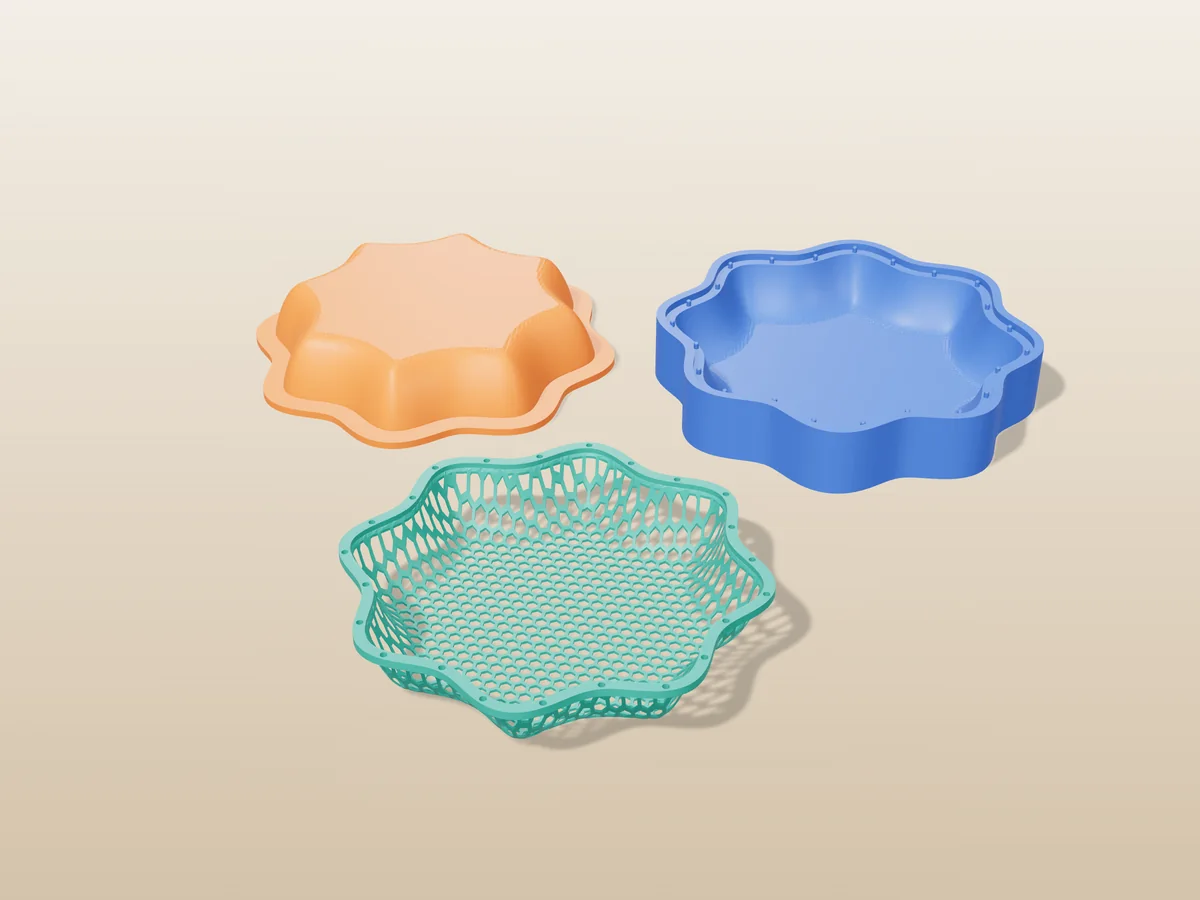
- Press it between a plug and a cavity. Industry calls this matched-die forming. The soft part is trapped in a gap one sheet thick everywhere at once, so it comes out the same shape every time and the edge cannot lift. This is what our free mesh former builds: upload any outline and it makes the flat mesh and a matching plug and cavity to press it in. The cavity even has a pocket cut to the mesh's rim, so the part locates itself.
Designing a part that forms instead of tearing
Most failed forms were decided on the screen, not at the heat gun. Four rules cover almost all of it:
- Thin where it bends, thick where it must not. A 1 mm net inside a 3 mm rim is the classic layout: the net goes limp long before the rim does, so the outline survives the heat. Make everything the same thickness and the outline softens at exactly the same rate as the middle.
- Stretch comes out of thickness. A flat part pressed into a dome has to cover more area than it started with, and every bit of that extra area makes it thinner. A 1 mm net that has to grow by half arrives at about 0.7 mm. Under roughly 0.6 mm, struts snap instead of stretching. Deep shapes need thicker nets.
- Meshes form better than solid sheets. A solid sheet has to stretch as one piece and wrinkles where it bunches up. In a mesh every cell can open or close a little on its own, so it follows compound curves much more willingly.
- Give the form a wall angle. A cooled part shrinks onto whatever it was pressed against. Straight sides grip it; sides that lean in by 10 degrees or so let it lift off.
The mesh former does this arithmetic for you: it reports how thin the net will get at the depth you pick and warns you before you print something that will tear.
What people make with it
The best projects are the ones where the holes are the point: to see, breathe, hear or let light through.
- Cosplay eye and mouth meshes. A curved mesh that sits flush in a helmet. We wrote a whole guide on cosplay eye mesh, with a free file to start from.
- Speaker grilles for radios, Bluetooth speakers and car audio builds.
- Vent and fan covers that follow a curved case.
- Bowls and dishes. A key bowl by the door, a ring dish, a light decorative bowl. Our scalloped mesh bowl and heart dish are free downloads.
- Ornaments and lanterns. Two formed halves pinned together make a closed shape, which is how the mesh former's "two halves" option works: a Christmas ornament with a hanging hole in its cap, or a pumpkin lantern round an LED tea light. Both are free downloads.
Common problems
Can you reshape a 3D print with heat?
Yes. Every common FDM filament goes soft and bendable a little above its glass transition temperature and sets again when it cools, so a thin print can be warmed, bent or pressed into a new shape, and it keeps that shape. It works best on parts that were designed for it: thin where they bend, thick where they must not.
Is PLA or PETG better for thermoforming?
PETG. It softens around 80 C and stays workable over a wide window, so it stretches instead of cracking and survives a little too much heat. PLA softens much sooner, around 60 C, but its window is narrow: a few degrees too cold and it cracks, a few too hot and it sags and turns brittle once it cools.
Can I use a hair dryer instead of a heat gun?
For thin parts, yes. A hair dryer on its hottest setting, held 10 to 15 cm away, softens a 1 mm PLA mesh in a minute or two, and a PETG one if you hold it close and are patient. It is too cool for ABS and for anything thicker than about 2 mm.
Why did my part spring back after forming?
It was released while still warm. The plastic only locks in its new shape once it has cooled below its softening point under pressure. Hold it on the form until it is cool to the touch, or speed that up with a damp cloth or a blast of compressed air.
Why did my mesh tear while I pressed it?
Either it was not evenly soft, or the shape asked it to stretch too far. A cold patch tears while the warm part around it stretches, so warm the whole area and not just the middle. And every bit of area a net gains going over a form comes out of its thickness: if a 1 mm net has to cover half again its flat area, it arrives at about 0.7 mm. Go shallower, or print it thicker.
Made by meshcast.app. Formed something? Email a photo, I'd love to see it.