Homemade Christmas candles: tree, taper and photo molds you print yourself
This guide was drafted with AI assistance.
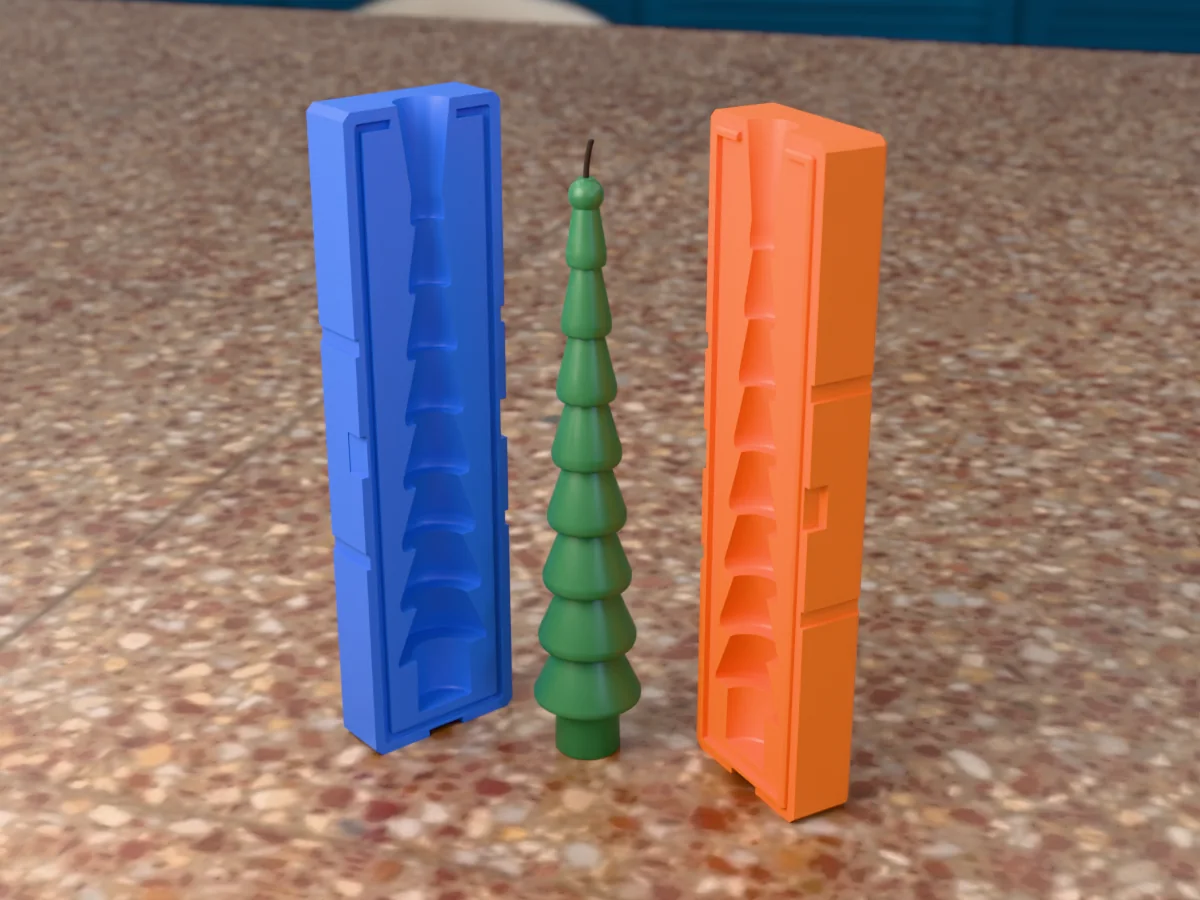
For homemade Christmas candles you print the mold, not the candle. Download a free Christmas candle mold (a tree taper, tiered tree, snowflake, gift box, bauble, gingerbread house or snowman), or build one around any shape with the candle mold generator. Print the two halves in PETG with 4 walls, clamp them, set the wick, and pour at the low end of your wax's range: soy 57 to 63 °C, paraffin 75 to 85 °C, never above 90 °C. Top up once, cool 4 to 6 hours, open. One mold pours a whole batch of gifts.
Upload any shape, or start from an image, and get a two-part candle mold with a pour funnel. Free, in your browser.
Open the candle mold maker →Free Christmas candle molds to print
Each of these is a finished mold in the free design library, made with our own tools, with the print time and filament listed on its page. The rigid ones are two halves that clamp shut with a pour funnel on top; no silicone needed.
| Candle | Size | Mold | |
|---|---|---|---|
| Christmas tree taper | about 195 mm, 22 mm plug | Rigid, 2 parts | about 11.5 h, 347 g |
| Tiered Christmas tree | 105 mm, star on top | Rigid, 2 parts | about 15 h, 443 g |
| Puffy snowflake | 91 mm across | Rigid, 2 parts | about 5 h, 155 g |
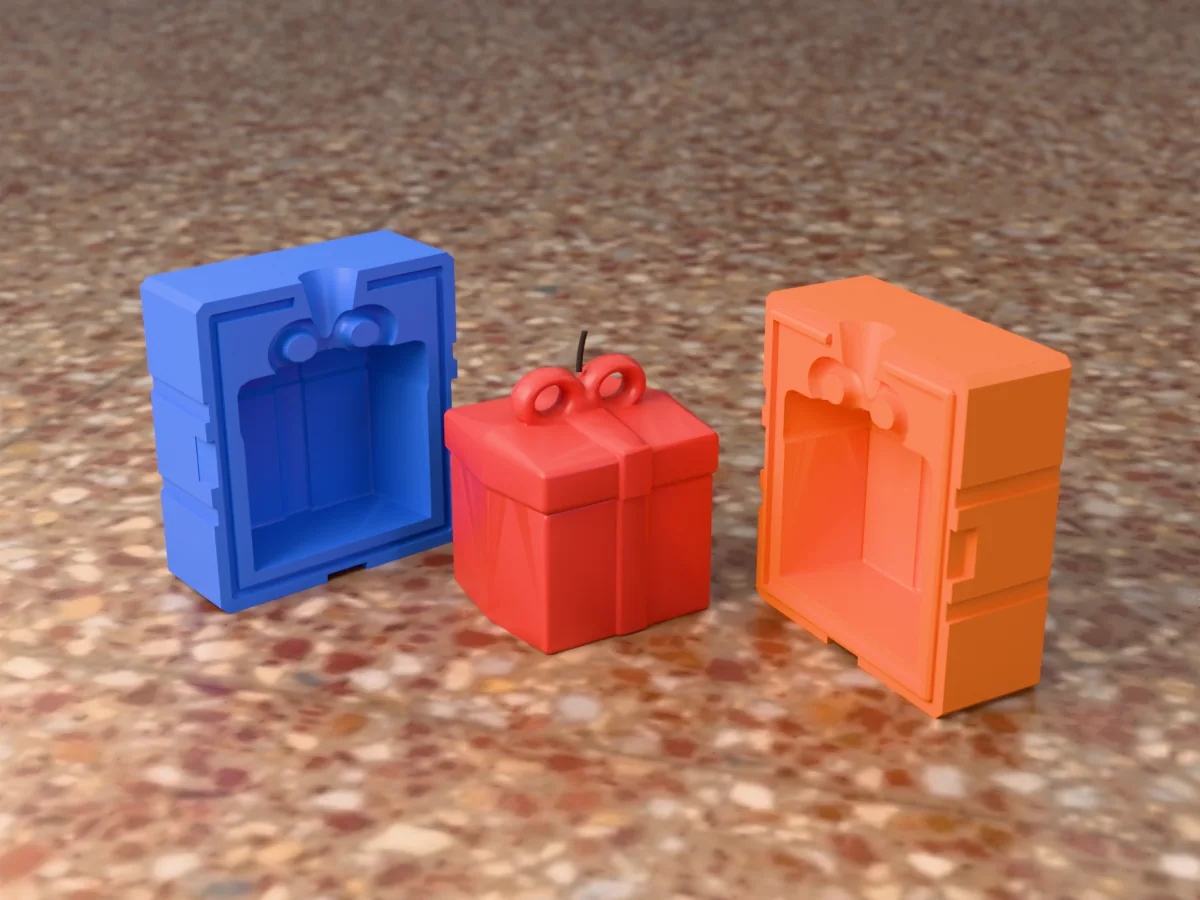
| Gift box with bow | 73 mm | Rigid, 2 parts | about 8 h, 246 g |
| Christmas bauble | 72 mm | Rigid, 2 parts | about 11.5 h, 350 g |
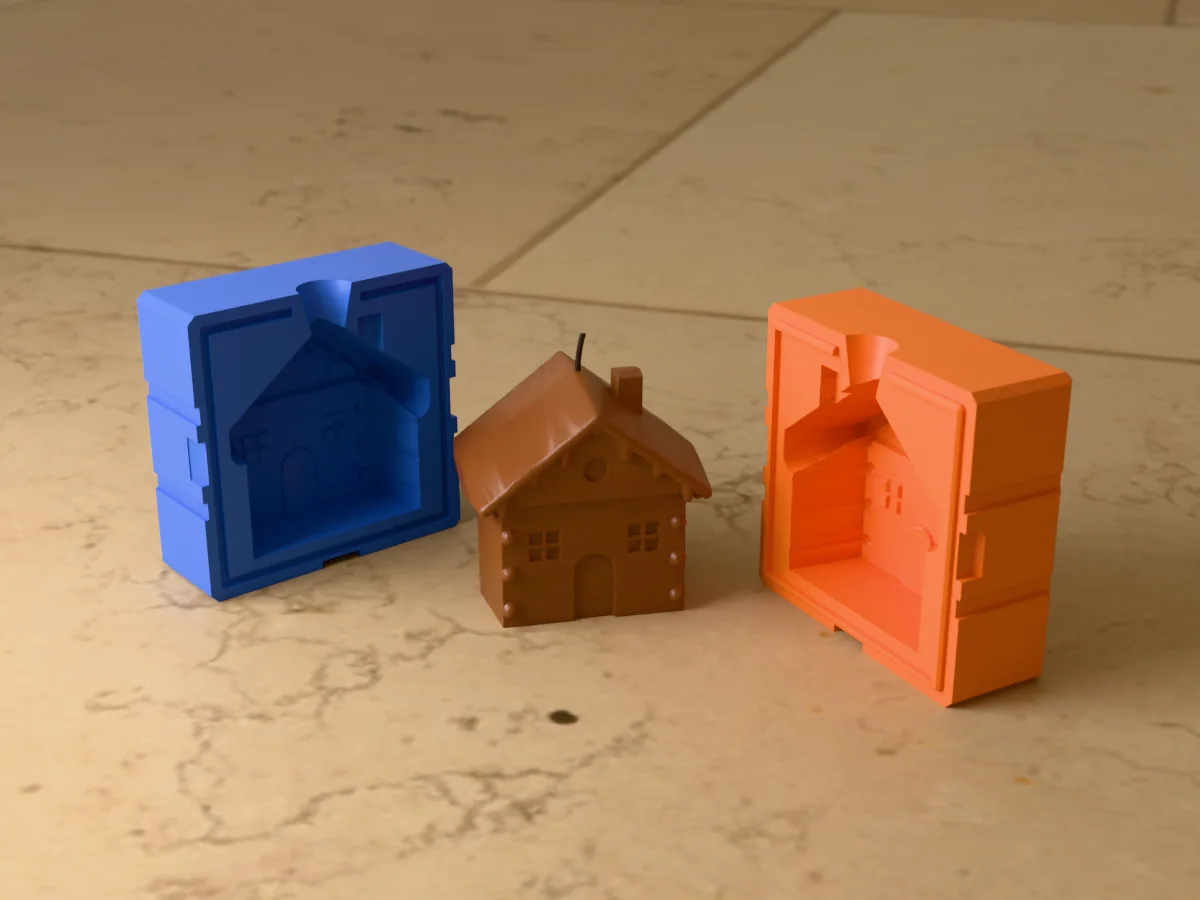
| Gingerbread house | 71 mm | Rigid, 2 parts | about 9 h, 272 g |
| Snowman | 112 mm | Rigid, 2 parts | about 11 h, 319 g |
| Puffy star | 82 mm across | Rigid, 2 parts | about 8 h, 245 g |
| Pine cone | 87 mm, 120 scales | Silicone, from a printed shell | about 9 h, 259 g, plus silicone |
| Layered Christmas tree | 84 mm | Silicone, from a printed shell | about 6 h, 183 g, plus silicone |
More in the same style: a bell, a gingerbread man, an angel and a knitted mitten. For wax melts, the Christmas tree wax melt tray pours eight at once with no silicone. Everything festive is in the Christmas collection.
Rigid two-part mold or silicone?
A rigid printed mold opens along one seam, so the candle has to slide straight out of both halves. That works for anything turned or puffy: a taper, a bauble, a star, a gift box. It does not work for a pine cone, where every scale hooks over the one below it.
| Rigid two-part (printed) | Silicone (cast from a printed shell) | |
|---|---|---|
| Best for | Tapers, baubles, stars, boxes, simple figures | Pine cones, deep texture, anything with undercuts |
| Extra cost | Only filament | Silicone, a few hundred ml per mold |
| Time to first candle | Print, then pour | Print, cast silicone, wait for it to cure, then pour |
| Surface | Copies the printed cavity, layer lines included | Copies the master, and flexes off fine texture without breaking it |
| Tool | Candle mold | Silicone mold maker |
The candle mold generator checks this for you: after you upload a shape it shows how much of it would lock in a rigid mold, and offers to fill the undercuts, add a third or fourth mold piece, or hand the model to the silicone mold maker. The silicone route is explained in silicone molds from a 3D print.
Printing a mold that does not leak
Hot wax is thin and finds every gap between layers. Most first attempts fail here, not at the pour.
| Setting | Use | Why |
|---|---|---|
| Material | PETG (PLA for a few cool pours) | PLA softens from around 60 °C, below a normal paraffin pour |
| Walls | 4 perimeters | Watertightness comes from walls, not infill |
| Layer height | 0.12 to 0.2 mm | Finer layers leave fewer paths for wax and a smoother candle |
| Infill | 20 to 40% | Stops the halves flexing under clamp pressure |
| Orientation | Parting face flat on the bed | The flattest mating face is what seals |
| Supports | None | The halves print as exported |
Pouring a Christmas candle, step by step
Set the wick
The mold has no wick hole of its own. Either drill a small hole through the base and thread the wick before closing the halves, or lay the wick in one half so it runs from the funnel to the foot. Use a primed wick sized for the candle's diameter: too thin and it tunnels, too thick and it smokes.
Clamp it shut
Close the halves over the wick and band or clamp them along the whole seam. Clamps hold better than bands as the wax cools and contracts. Pull the wick taut and clip it across the funnel so it stays centred.
Melt with a thermometer
Melt the wax in a double boiler, never on direct heat, and watch the thermometer. Add color and scent as the wax's maker recommends.
Pour cool and slow
Pour at the low end of the range for your wax, in a thin stream, tapping the mold so the tiers or points fill. Cooler wax finds fewer leaks and shrinks less as it sets.
Top up
Wax contracts, and the last liquid pulls down into the middle. Keep some back and top up the funnel once the surface has skinned over.
Cool, chill, open
Leave it 4 to 6 hours at room temperature, then half an hour in the fridge: the candle shrinks slightly more than the mold and drops out. Open at the pry pockets, cut the pour stub flush, trim the wick, and level the foot on a warm pan if it rocks.
Wax and color for Christmas candles
| Wax | Pour at | Result | In a printed mold |
|---|---|---|---|
| Soy | 57 to 63 °C | Creamy, natural, holds scent well | Kindest to the mold, easiest to start with |
| Paraffin | 75 to 85 °C | Hard, glossy, sharp detail, strong colors | Wants a thick wall; PETG if you pour often |
| Beeswax | 70 to 80 °C | Golden, honey-scented, long burn | Sticky: chill well before opening |
| Coconut blend | 55 to 65 °C | Very smooth surface, soft | Cool pour, easy on the mold |
For the table: tree tapers in forest green, white or gold, two or three together. For gifts: one mold, a different color for each person. Wick sizing and the full wax background are in how to make a candle from a 3D printed mold.
Make a mold for your own Christmas shape
The candle mold generator builds a mold around whatever you give it:
- Any STL. An angel figurine, a reindeer, a nativity piece. Upload it, set the size in millimetres and the seam position, and it builds two halves with alignment keys, rubber-band grooves and a pour funnel. Add pour holes for shapes with several high points.
- An image or a logo. No 3D model? Upload a picture of a star, a tree or a snowflake and it becomes a candle shape, raised, engraved or plain, 90 mm high by default.
- A word. "NOEL" or "JOY" as a candle comes from the text sign designer, then goes into the mold tool.
Shapes with a flat back, like a star or a word, can use an open mold instead: one piece, the model lies face down and you pour from the top. The tool marks which mold type suits your shape. The full workflow is in the candle mold guide.
A photo candle
The most personal Christmas candle of all shows a photo when it is lit. The photo candle designer wraps a picture round a candle as a relief: thin wax where the photo is bright, thick where it is dark. One click sends it to the two-part mold tool. Pour pale, undyed wax below about 85 °C; once the flame sits down inside the candle, the wall glows and the photo appears. Rotate the image so the mold seam lands on the background, not a face. Step by step: photo candle mold. Prefer a photo that glows without wax? See the lithophane Christmas gift.
Christmas candle molds
All Christmas designs →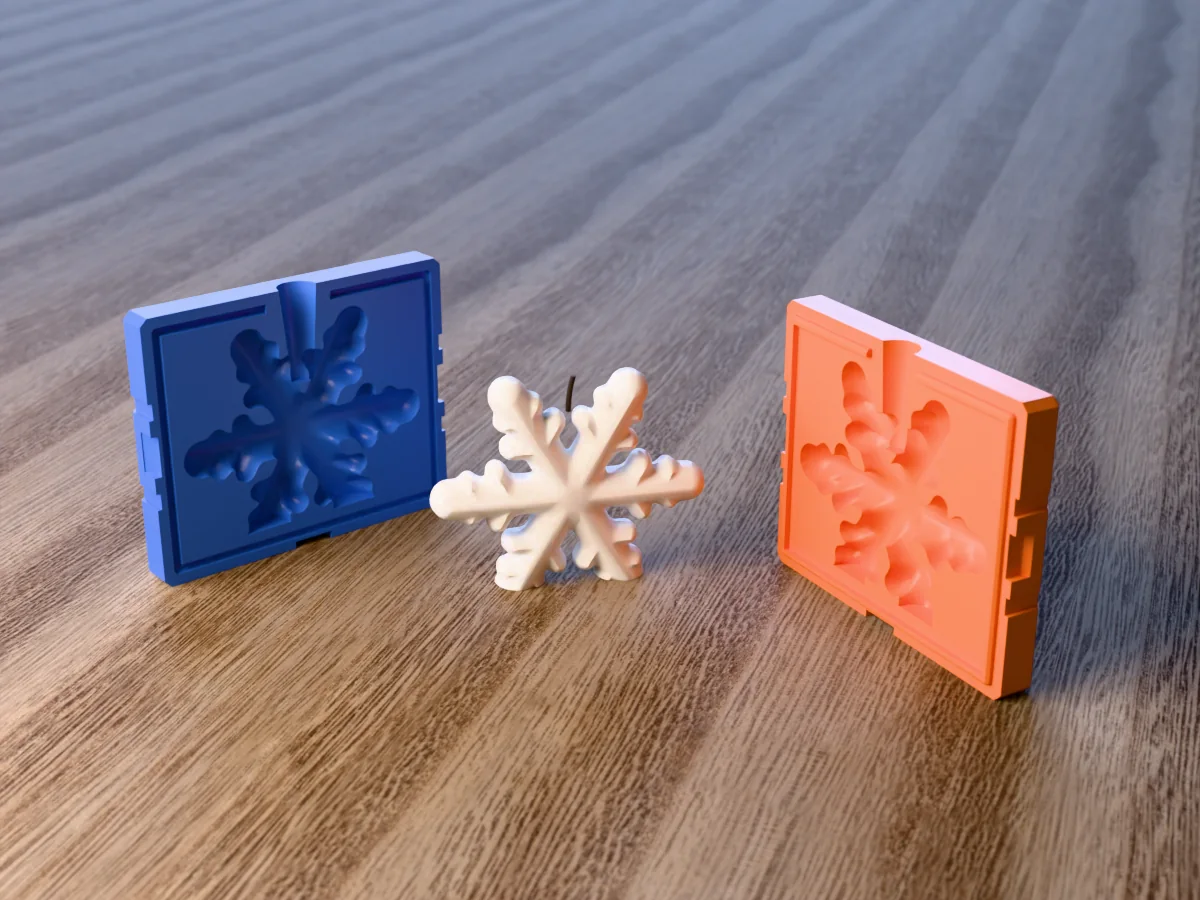
Problems
Wax leaked out of the seam
Cause The halves are not closing flush, or wax is weeping through the wall.
Fix Clean both mating faces, check for a blob or elephant's foot on the first layer, clamp instead of only banding, pour cooler, and reprint with more walls if it comes through the wall itself.
The mold warped after a few pours
Cause PLA and hot wax.
Fix Reprint in PETG and pour at the low end of your wax's range, or switch to soy.
There is a crater in the top of the candle
Cause Normal shrinkage as the wax sets.
Fix Top up once the first pour has skinned over.
The candle will not come out
Cause Wax still warm, or the shape has an undercut a rigid mold cannot release.
Fix Half an hour in the fridge. If it still sticks, check the shape in the candle mold tool's undercut view, or make a silicone mold for it.
The wick drifted off centre
Cause It was not held taut while the wax set.
Fix Pull it tight and clip it across the funnel before pouring. An off-centre wick tunnels down one side.
FAQ
Can you make candle molds with a 3D printer?
Yes. You print the reusable mold, not the candle: two rigid halves that clamp shut, with a pour funnel on top. Shapes with heavy undercuts, like a pine cone, are printed as a shell instead and cast in silicone, and the silicone mold is what you pour wax into.
Will PLA melt from hot wax?
It softens rather than melts. PLA starts to soften around 60 °C and paraffin pours at 75 to 85 °C, so a PLA mold survives on thick walls and the wax cooling fast, and warps a little every hot pour. PETG handles it better. Pour at the low end of your wax's range and never above 90 °C.
What wax is best for homemade Christmas candles?
Soy is the easiest to start with and the kindest to a printed mold, because it pours cool at 57 to 63 °C. Paraffin gives sharper detail and the brightest colors but pours hotter. Beeswax is golden and smells of honey but is sticky to release. For a photo candle, use pale, undyed paraffin or a light soy blend.
How do I put the wick in a 3D printed candle mold?
The mold has no wick hole of its own. Drill a small hole through the base and thread the wick before closing the halves, or lay it in one half from the funnel to the foot. Pull it taut and hold it centred across the funnel with a clip or wick bar, or add the wick after the pour with a heated wick needle.
Does a 3D printed Christmas tree taper fit a normal candlestick?
The free Christmas tree taper mold makes a candle with a 22 mm plug at the foot, the 7/8 inch size standard taper holders take. If a holder is tight, warm the plug in your hand for a few seconds or shave it with a knife.
How many candles can I pour from one printed mold?
A well printed PETG mold survives dozens of pours if you keep the wax temperature sensible. A PLA mold poured hot may last only a few. That is why it pays to print the mold early, test it once, and then pour a whole batch of gifts from it.
Made by meshcast.app. Poured one for the Christmas table? Send a photo, we'd love to see it.